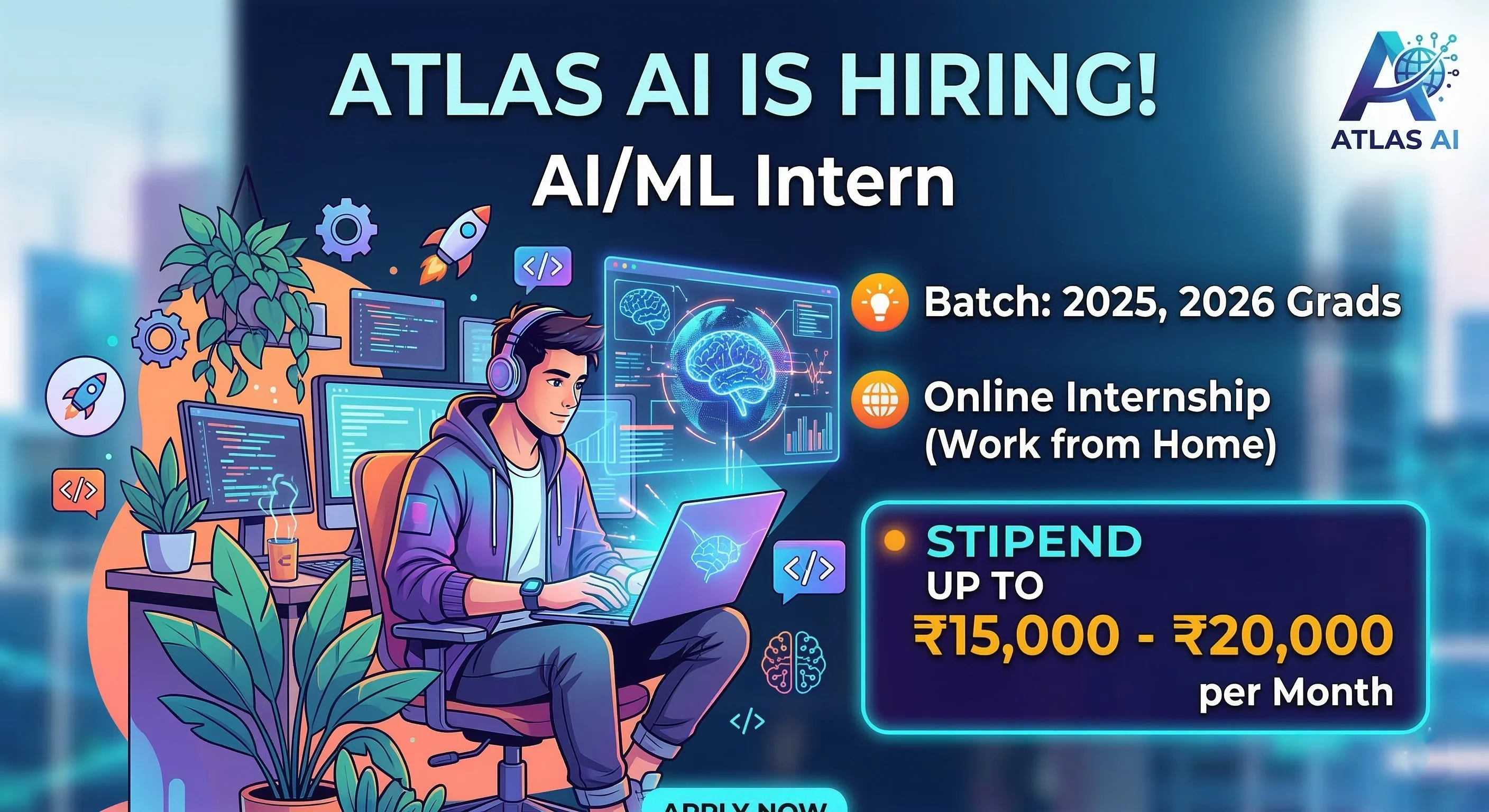
If you are in your final year or recently graduated and searching for a serious AI/ML internship in India, this role from Atlas AI is one of the strongest practical opportunities right now. The company is hiring freshers for an AI/ML Intern position focused on real production workflows, not just demo notebooks or classroom assignments.
This internship is especially relevant for candidates who enjoy solving messy, real-world data problems and who can work with ambiguity. The role includes building evaluation pipelines, improving extraction quality, analyzing model failures at scale, and helping ship agentic systems used in regulated BFSI operations.
In short, this is not a passive internship. If selected, you will work close to the AI leadership and contribute directly to production-facing systems. In this guide, we break everything in a practical and human way: eligibility, what Atlas AI looks for, what your day-to-day could look like, preparation strategy, and a direct apply link.
Table of Contents
- Atlas AI Recruitment 2026 Overview
- About the Job
- What Atlas AI Is Looking For
- What You Will Do as an AI/ML Intern
- Perks and Growth Opportunity
- Company Overview and Key Aspects
- How to Prepare for This Internship
- How to Apply
- More Also Read
Atlas AI Recruitment 2026: Quick Overview
| Company Name | Atlas AI |
| Post Name | AI/ML Intern |
| Experience | Final year students / recent graduates (freshers eligible) |
| Qualification | CS, Statistics, or related technical fields |
| Job Location | India (city-level address not specified in listing) |
| Stipend | As per company norms (not publicly disclosed) |
| Core Skill Priority | Strong Python + practical ML evaluation mindset |
| Apply Link | Official link provided in listing |
About the Job
Atlas AI describes itself as an agentic AI platform built for Indian banks and NBFCs, with focus on automating exception-heavy operations such as onboarding, credit, and compliance. The company mentions that it is already live in production with financial institutions, which is important because it means the intern role likely works with real data and production constraints.
From a career point of view, this makes the internship more valuable than generic internships where tasks are mostly synthetic. Here, performance quality, confidence calibration, and failure analysis have direct operational impact. You are expected to think like an engineer who can move from experiment to reliability.
Another interesting part is the clear emphasis on evaluation quality. Many candidates focus only on model building and forget practical eval systems. Atlas AI is explicitly hiring for people who can design and maintain evaluation workflows, create quality datasets, and find patterns in model errors. That is exactly what top AI teams care about in 2026.
What Atlas AI Is Looking For
- Final year student or recent graduate in Computer Science, Statistics, or related domain.
- Strong proficiency in Python. Not basic familiarity, but comfortable and productive coding.
- Some exposure to LLMs: API usage, prompt testing, reading model behavior and outputs.
- Practical understanding of ML evaluation metrics like precision, recall, and confidence calibration.
- Comfort with messy datasets and open-ended problem statements.
- Familiarity with evaluation stacks such as Promptfoo, Arize, or custom Python pipelines is a plus.
- Bonus if you have worked with OCR, document AI, or multimodal model workflows.
One strong signal from this requirement list: they value curiosity plus execution. You do not need to be a research scientist already. But you do need to show that you can test ideas, measure outcomes properly, and improve weak points based on data.
What You Will Do as an AI/ML Intern
- Build and maintain evaluation pipelines for document intelligence and agentic workflows.
- Create high-quality labeled ground-truth datasets across document types and language variations.
- Run structured experiments for prompt strategies, extraction quality, and model confidence.
- Analyze model output at scale, detect failure clusters, and collaborate with AI engineers on fixes.
- Contribute to agentic onboarding products using production-like real-world data.
In practical terms, this role combines parts of ML engineering, evaluation engineering, and quality analytics. For freshers, that is excellent exposure because these are the skills companies increasingly screen for in AI hiring.
A Typical Week Could Look Like This
Monday: You validate last week experiments, compare extraction accuracy, and flag confidence drift in edge cases.
Tuesday: You expand ground-truth datasets with difficult document samples, especially regional language and low-quality scans.
Wednesday: You run prompt and model strategy experiments, log outcomes, and check precision-recall trade-offs by use case.
Thursday: You collaborate with the AI team to patch repeated failure patterns and improve robustness.
Friday: You summarize findings, report metrics, and propose next-week experiments with clear success criteria.
This rhythm teaches something many fresher candidates miss: high-impact AI work is not only model training. It is disciplined measurement, reproducible experiments, and clear communication of trade-offs.
Perks and Career Upside
- Direct collaboration with the Chief of AI on live production-grade systems.
- Strong pre-PPO pathway for high performers.
- Potential full-time conversion with equity component.
- Startup environment where your contribution is visible, measurable, and impactful.
- Stipend aligned with high-growth pre-seed startup expectations.
For many students, the biggest value is not just stipend. It is the quality of learning loop: rapid feedback, real failure debugging, and opportunity to own tangible improvements. If you want to accelerate your AI engineering maturity in one internship cycle, this type of environment helps a lot.
Atlas AI Company Overview and Key Aspects
The provided company context includes both a BFSI-focused agentic AI narrative and a broader Atlas AI profile known for geospatial AI and socioeconomic forecasting. Both directions highlight a common pattern: Atlas AI is positioned around practical, decision-grade AI systems rather than purely academic experiments.
Key Aspects Highlighted
- Applied Intelligence Focus: Turning large, complex data streams into operational decisions.
- Mission Orientation: Product design tied to measurable impact in regulated or high-stakes domains.
- Platform Approach: API-first systems designed for integration with existing enterprise workflows.
- Strong Research DNA: Deep ties to academic and technical foundations with applied execution.
- Enterprise Partnerships: Collaboration with institutions and infrastructure-heavy domains.
If you are preparing your application, focus your resume toward this style: practical ML pipelines, measurable outcomes, experimentation rigor, and evidence of working through ambiguous problem definitions.
How to Prepare for Atlas AI AI/ML Intern Selection
1) Strengthen Python the Practical Way
Be comfortable with data wrangling, text processing, regex cleanup, JSON handling, and experiment logging. This role will likely involve document-heavy inputs and iterative analysis, so Python fluency matters more than competitive coding speed alone.
2) Build One Solid Evaluation Project
Create one project where you compare prompts/models on a small labeled dataset and report precision, recall, and confidence behavior. Even a well-documented mini project can outperform ten vague resume bullets.
3) Learn Failure Analysis Mindset
During preparation, do not just celebrate average accuracy. Inspect where the system fails. Is it language variation, OCR noise, format mismatch, or confidence overestimation? Teams hiring for evaluation engineering care about this thinking.
4) Prepare for Role-Based Questions
- How would you design an eval pipeline for multilingual document extraction?
- How do you choose between precision and recall in a compliance-critical workflow?
- What does confidence calibration mean in production, and why does it matter?
- How would you detect model drift or failure clusters over time?
5) Resume Tips That Increase Shortlisting Probability
- Show measurable output: "Improved extraction precision from X to Y" is stronger than "Worked on NLP".
- Include links to code or notebooks that actually run.
- Mention tooling and methodology, not only final metrics.
- Keep project descriptions outcome-first and concise.
- Highlight ambiguity handling, not only textbook ML implementation.
Who Should Apply
You should strongly consider this role if you are curious, technically hands-on, and comfortable learning fast in uncertain environments. Candidates who enjoy measuring model behavior, building repeatable quality workflows, and improving real systems will fit well.
If your current profile is mostly academic, do not worry. Build one practical evaluation project in the next few days, document it clearly, and apply with confidence. For fresher hiring, signal quality matters as much as depth.
How to Apply for Atlas AI AI/ML Intern Role
Use the official application link provided in the listing and fill all details carefully. Keep your resume updated with practical ML/LLM projects and make sure your project links are accessible.
Important: Always verify role details on the final application page before submitting, including company name, title, location, and requisition information.