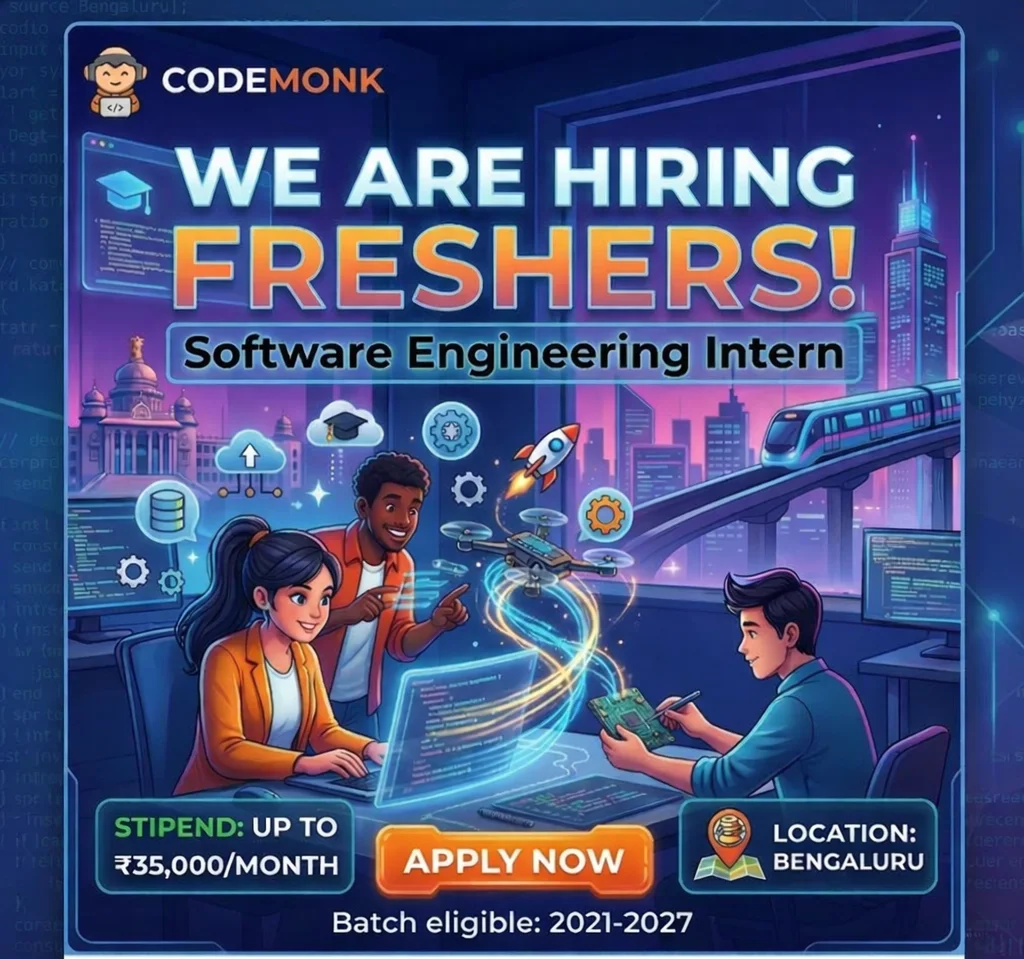
If you are a fresher or final-year student looking for a backend internship where you can learn real product engineering, this opening is worth serious attention. Codemonk is hiring for Software Engineering Intern - Backend in Bengaluru, and the stipend can go up to Rs 35,000 per month based on your profile, assignment quality, and overall fit.
Many internships sound exciting on paper but end up being documentation-only roles. This one is different because the expectations are clear: build and improve APIs, ship backend features, work with role-based access control, fix bugs, and contribute to production-facing systems. In simple words, this is not just a line on your resume, it can become your strongest practical backend experience.
In this detailed guide, you will find role highlights, eligibility, required skills, likely interview flow, realistic preparation strategy, and the official apply link. The format follows our most-read hiring breakdowns so you can quickly decide whether this is the right opportunity for your profile.
Table of Contents
- Codemonk Recruitment 2026 Overview
- Role Snapshot: Software Engineering Intern - Backend
- Detailed Responsibilities
- Skills Required
- Stipend and Benefits (up to Rs 35,000)
- Hiring Process at Codemonk
- How to Prepare and Stand Out
- How to Apply for Codemonk Internship
- Also Read
- FAQs
Codemonk Recruitment 2026:
| Company Name | Codemonk |
| Post Name | Software Engineering Intern - Backend |
| Role Type | Internship (4-6 months) |
| Salary / Stipend | Up to Rs 35,000 per month (as per company evaluation and norms) |
| Experience | Freshers / students with strong Python backend basics |
| Job Location | Bengaluru, Karnataka |
Software Engineering Intern - Backend: Role Snapshot
Codemonk is looking for a Python-focused backend intern who can contribute to real engineering outcomes. The core problem statement is straightforward: maintain and improve REST APIs, support role-based access control, and help build new features while preserving data integrity in multiple systems.
This role is ideal for candidates who enjoy writing clean backend logic, understanding how systems communicate, and debugging edge cases instead of avoiding them. The team values ownership and adaptability, which means you may work on API improvements one week and touch microservices, cloud setup, or data tooling in another.
For many freshers, the biggest challenge is moving from tutorial projects to production thinking. This internship can bridge that gap because the expectations include code quality, debugging discipline, and lifecycle participation, not just one isolated coding task.
Detailed Roles and Responsibilities
Based on the role description and common backend internship patterns in product teams, here is what your work may involve on a weekly basis:
- Build and improve REST APIs: Design endpoint behavior, validate requests, manage response consistency, and keep API contracts clean for frontend and integration teams.
- Maintain role-based access control: Help enforce permissions correctly so users can only access what they are authorized to see or update.
- Debug production-like issues: Track failing flows, inspect logs, reproduce bugs, identify root causes, and ship reliable fixes.
- Work across backend stack pieces: Contribute to Django applications, microservices, data tools, and cloud or DevOps workflows as needed.
- Participate in complete lifecycle: Understand a task from requirement to implementation, testing, rollout, and post-release monitoring.
- Ship features with accountability: Own your module, suggest practical improvements, and keep an eye on corner cases before release.
- Document engineering learnings: The role encourages writing technical posts whenever you learn and ship something meaningful.
A notable line in this role is to "learn technologies that are distributed in nature." For freshers, this is a high-value exposure because distributed design principles are directly relevant to modern backend careers. Even if you begin with simpler tasks, understanding stateless services, retries, idempotency, and observability can accelerate your growth significantly.
Skills Required (What They Are Really Looking For)
The listed skills are practical and realistic for a fresher internship, but the evaluation usually goes deeper than buzzwords. Here is how to interpret each requirement:
- Python proficiency: You should be comfortable with data structures, functions, classes, error handling, and writing readable production-style code.
- Django or at least one Python web framework: Django is preferred, so understand models, serializers, views, URL routing, middleware basics, and authentication flows.
- Strong interest in web application building: Be ready to discuss one project where users interact with your backend in a meaningful flow.
- Problem-solving mindset: The team expects creative solutions to practical system problems, not copied snippets.
- Adaptability with new tools: Interns may need to pick up a new library, framework, or cloud practice quickly.
- Communication skills: Clear written and verbal communication matters because backend work is cross-functional.
- Availability for 4-6 months: Mention your joining window and commitment duration clearly in your application.
One important point: "purist Python developer" does not mean academic perfection. It typically means clarity, maintainability, and strong fundamentals. If your code is simple, tested, and understandable, you are already aligned with what most backend teams prefer.
Salary and Benefits: Is "Up to Rs 35,000" Realistic?
Codemonk indicates a competitive internship compensation and this opening is being discussed with a stipend range that can go up to Rs 35,000 per month. Final payout commonly depends on your skill depth, assignment performance, and prior practical exposure.
Beyond stipend, the benefits mentioned for this role are highly relevant for freshers:
- Learning and Development: Better than passive training, you learn through real product tasks and team feedback.
- Flexible Working Hours: Helpful for students balancing academics and internship outcomes.
- Competitive Salary: Good compensation for a fresher backend role can reduce financial pressure and improve focus.
In the first 12-18 months of your career, practical backend ownership plus mentorship is often more valuable than a short-term salary difference. So evaluate this internship on both learning curve and compensation, not just stipend numbers alone.
An Overview of Codemonk Hiring Process
Codemonk shares a transparent four-step recruitment flow. Here is what each step usually means and how you can prepare:
Step 1: Telephonic Screening
This is a short, friendly conversation to understand your profile and intent. They may ask about your current status, projects, internship availability, and why you prefer backend engineering. Keep your answers clear, concise, and genuine.
Step 2: Assignment
You may receive a role-relevant backend assignment. Typical tasks include API endpoint design, input validation, authentication checks, error handling, or performance-friendly query patterns. Focus on code readability, correctness, and edge-case thinking.
Step 3: Technical Rounds
One or more technical interviews can follow. Expect questions on Python basics, Django concepts, REST principles, database choices, debugging approach, and project architecture decisions. Interviewers often value reasoning more than memorized definitions.
Step 4: Cultural Round
This stage checks whether your work style aligns with the team. You may discuss collaboration, ownership, communication habits, and how you handle feedback. Ask thoughtful questions about team workflows and mentoring style to show maturity.
If you understand this flow early, your preparation becomes targeted and less stressful. Most applicants fail not because they are weak technically, but because they do not prepare the right narrative for each round.
How to Prepare in a Practical Way (Freshers Roadmap)
If you want to maximize your chances in the next 2-4 weeks, use this focused plan:
- Build one backend project deeply: For example, a role-based task manager API with JWT auth, pagination, and audit logs.
- Add quality signals: Include README setup steps, sample API requests, Postman collection, and simple tests.
- Revise debugging fundamentals: Understand stack traces, logging strategy, and how to isolate the root cause quickly.
- Practice Django interview basics: ORM queries, serializers, middleware, migrations, and performance optimization.
- Prepare communication answers: Why backend, what you learned from bugs, and how you handle ambiguous requirements.
- Show engineering thinking: Mention trade-offs, not just implementation. Explain why you chose one approach over another.
High-Impact Resume Checklist for This Role
- Resume headline should include Python and Backend keywords clearly.
- Projects should include measurable outcomes, not just technology names.
- GitHub links must open correctly with clean repository structure.
- Mention internship duration availability (4-6 months) explicitly.
- Add one short line on debugging or production issue resolution if possible.
Common Mistakes to Avoid
- Applying with generic resumes that do not mention backend skills.
- Submitting assignment code without validation, error handling, or documentation.
- Overstating skills but failing to explain project decisions in interviews.
- Ignoring communication quality in mails and interview conversations.
- Not testing APIs with edge cases before submission.
Why This Opportunity Stands Out for Freshers
For a fresher, the best internship is one where you can learn architecture thinking while still shipping visible features. Codemonk's opening combines exactly that: Django and API development, distributed technology exposure, bug-fixing ownership, and product lifecycle participation.
Another strong point is writing engineering blogs after shipping work. This habit builds technical communication, strengthens your public profile, and creates proof of learning that helps in future full-time interviews.
If you are serious about becoming a backend engineer and want to move beyond theory, this role gives enough technical depth to become career-defining when approached with discipline.
How to Apply for Codemonk Internship
Interested and eligible candidates can apply directly using the official link below. Before applying, update your resume, ensure project links are working, and keep your internship availability window clearly mentioned.
Final Takeaway
Codemonk Software Engineering Intern - Backend in Bengaluru is a high-value internship for freshers who want practical Python backend exposure with strong ownership. With stipend potential up to Rs 35,000, flexible hours, and a clear hiring structure, this role is suitable for candidates who can learn fast and execute with consistency.
Prepare smartly, not randomly. Strengthen one project deeply, write clean APIs, practice debugging, and communicate your thought process clearly. That combination can significantly improve your shortlisting and interview performance.
Quick reminder: roles can close early based on hiring volume. Apply as soon as possible if your profile aligns.
Also Read
- Unisys Hiring Student Tech Intern 2026/2027 in Bangalore
- Atlas AI Hiring Freshers for AI/ML Intern 2026
- GE Appliances Hiring Freshers for Technology Intern 2026
- Microsoft Hiring Freshers for Research Sciences Intern 2026
- GitHub Copilot Student Plan 2026: Model Access Changes
- IBPS Recruitment 2026: Massive 15,736 Clerk/CSA Vacancies
FAQs
1. Who can apply for Codemonk Software Engineering Intern - Backend?
Freshers and students with strong Python fundamentals can apply. If you know Django and have one practical backend project, your profile becomes more competitive.
2. What is the salary or stipend for this internship?
The stipend can go up to Rs 35,000 per month depending on your technical performance, assignment quality, and role fit.
3. Is this role only for Python developers?
Python is the main requirement. However, interns are also expected to adapt quickly and may work with microservices, data tools, cloud tasks, and related technologies.
4. Is the internship remote or on-site?
The listed location is Bengaluru. Unless the company mentions otherwise during hiring, prepare for an on-site or hybrid expectation based on team policy.
5. What is the internship duration?
The expected duration is 4-6 months, so ensure you can commit for the full term before applying.
6. What rounds are included in the Codemonk hiring process?
The process usually includes telephonic screening, assignment, technical interview rounds, and a cultural fit round.
7. How can I improve my chances of selection?
Keep your resume focused on backend work, add measurable project outcomes, submit clean assignment code, and explain your problem-solving approach clearly in interviews.