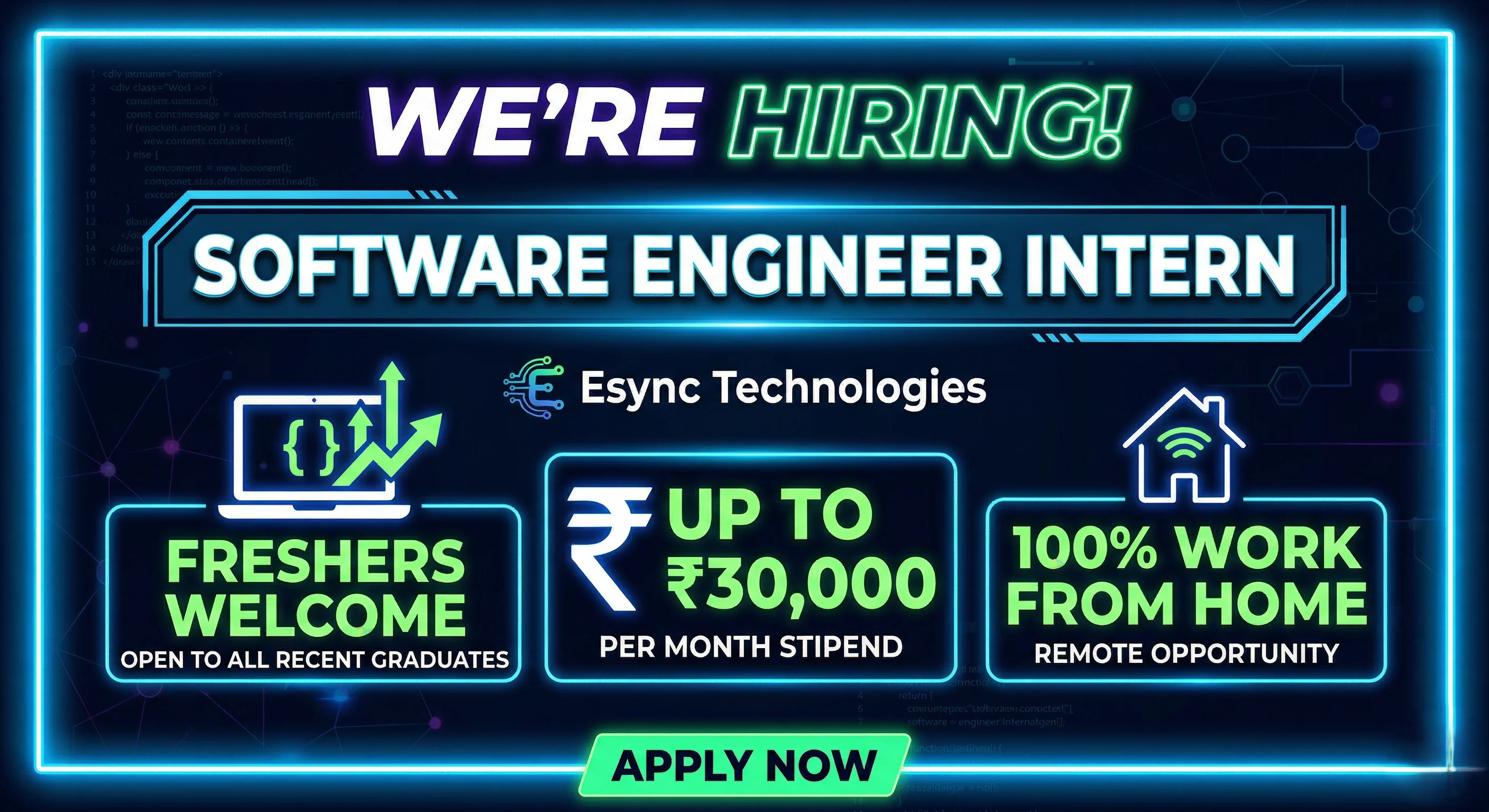
If you are looking for a remote software internship in 2026 that is paid, practical, and career-building, this is one of the strongest openings right now. Esync Technologies is hiring freshers for Software Engineer Intern with a monthly stipend range of INR 20,000 to INR 60,000, flexible hours, and a possible full-time conversion for top performers.
Most internship posts sound exciting but remain vague about what you actually do once selected. This one is different. The role clearly focuses on real software work: building web applications, integrating APIs, debugging performance issues, and collaborating with a remote engineering team. If you are someone who learns by building, this opportunity aligns well with that approach.
In this complete guide, we break down the official role details and translate them into practical advice you can use immediately. You will understand eligibility, expected skills, compensation reality, how to write a stronger application response, and what to revise before the technical assessment. Read it end to end before applying, because small improvements in your application quality can significantly improve shortlist chances.
Table of Contents
- Esync Software Engineer Intern: Quick Highlights
- About Esync Technologies and Why This Opportunity Matters
- Role Overview: What You Will Actually Work On
- Key Responsibilities Explained in Practical Terms
- Required Skills and Preferred Skills
- Who Can Apply and Eligibility Checklist
- Stipend, Benefits, and Work Structure
- Selection Process and How to Prepare
- How to Apply (with a strong short response format)
- 30-Day Preparation Plan for Better Shortlisting
- Common Mistakes to Avoid in Applications
- Final Takeaway, Apply Link, Also Read, FAQs
Esync Software Engineer Intern: Quick Highlights
| Company | Esync Technologies |
| Role | Software Engineer Intern |
| Location | Work From Home (India preferred) |
| Internship Type | Full-Time or Part-Time (Flexible) |
| Duration | 12 months (extension or full-time offer possible) |
| Stipend | INR 20,000 to INR 60,000 per month |
| Start Date | Immediate |
| Minimum Weekly Hours | 20 hours per week |
| Selection Stages | Application review, technical assessment, final interview |
About Esync Technologies and Why This Opportunity Matters
Esync Technologies operates in the IT services and consulting space and positions itself as a future-focused technology partner. The company talks heavily about digital transformation, practical innovation, and helping both organizations and individuals grow through modern technology. For freshers, the important part is not marketing language. The important part is whether the role gives real engineering exposure, and this internship appears to do exactly that.
According to the company profile and role details, the team works on software systems that combine web engineering, automation, and AI-enabled use cases. This is relevant because early-career engineers benefit the most when they are exposed to cross-functional products instead of one small isolated task. You build stronger fundamentals when you touch frontend, backend, APIs, quality checks, and deployment flow in one project cycle.
Esync also highlights commitments around career growth, mentorship, and self-paced learning. If that support translates into real team behavior, candidates can gain far more than just a certificate. A good internship can improve coding depth, project confidence, communication quality, and hiring outcomes for your next role.
Role Overview: What You Will Actually Work On
This is a hands-on, build-focused internship. It is not a passive observer role where interns only attend meetings or make cosmetic changes. The description indicates that interns will contribute to production-level systems, including web applications, AI tools, and interactive platforms.
In practical terms, that means you should be ready to write and review code regularly, understand requirements with clarity, and ship usable outputs. Teams that work asynchronously in remote mode value independent execution. So your consistency, communication, and ownership are just as important as your technical fundamentals.
If you are currently building small projects but want to transition into real-world software workflows, this internship offers the kind of environment that can accelerate your growth faster than random freelance practice.
Key Responsibilities Explained in Practical Terms
- Develop and deploy scalable web applications: You should be able to move from coding features to shipping usable versions with clean structure.
- Work on frontend and backend systems: Expect full-stack exposure, even if your primary strength is one side.
- Integrate APIs and third-party services: You may work with external auth, payments, communication APIs, analytics, or AI APIs.
- Write clean and maintainable code: Readability, modular design, naming clarity, and basic documentation will matter.
- Debug, test, and optimize: You should identify bottlenecks, fix defects, and improve responsiveness.
- Collaborate with a remote engineering team: Clear updates, reliable delivery, and async communication discipline are expected.
Notice that every line points to execution, not just theoretical knowledge. This is good news for candidates with project-based learning. Even if your profile is not perfect, a working portfolio with thoughtful engineering decisions can help you stand out.
Required Skills and Preferred Skills
The core requirement is simple: strong programming fundamentals with hands-on coding confidence. You should know at least one language well enough to build features and solve medium-level logic problems.
Required Skills
- Strong programming fundamentals.
- Proficiency in JavaScript, Python, or Java.
- Basic web development understanding (HTML, CSS, backend concepts).
- Familiarity with Git and GitHub workflows.
Preferred Skills (Not mandatory, but high value)
- React.js or Next.js for frontend architecture.
- Node.js or Express.js for backend APIs.
- MongoDB or PostgreSQL for database work.
- API development and integration experience.
- Deployment familiarity (Vercel, AWS, Firebase).
- Exposure to AI or ML APIs and tools.
Many freshers worry because they do not have every preferred skill. Do not overthink that part. Build one complete project showing clean logic, API usage, and solid README documentation. One polished project often creates a better impression than five unfinished repositories.
Who Can Apply and Eligibility Checklist
Based on the listed criteria, this role is suitable for students and recent graduates who are available to work remotely and can start soon. A quick self-check before applying:
- You are available to work from home.
- You can start immediately or within a short time.
- You can commit for at least 3 months.
- You have relevant coding skills or clear project experience.
- You are a student or a recent graduate interested in software development.
If all five points are true for you, this role is worth applying to immediately. Early applications are prioritized, so delay can directly reduce your visibility.
Stipend, Benefits, and Work Structure
The stipend range is one of the strongest highlights: INR 20,000 to INR 60,000 per month. This is performance-based, so output quality, ownership, and reliability are likely to influence where you land in that range.
Additional benefits include internship certificate, recommendation letter, flexible work hours, possible performance-based increments, and a pre-placement offer pathway for top performers. For candidates planning a long-term software career, PPO potential can become a major advantage because it reduces future placement pressure.
The work structure is fully remote and asynchronous, with a minimum weekly commitment of 20 hours. That flexibility helps students balance academics while still delivering real outputs. But remember: flexible schedule does not mean casual quality. Output-driven teams care deeply about deadlines and consistency.
Selection Process and How to Prepare
The process is straightforward and common for quality internships:
- Application review
- Technical assessment
- Final interview
To improve your probability of moving through all three rounds, prepare in this sequence. First, clean your resume and GitHub so the application review stage has strong evidence. Second, practice coding and debugging for assessment rounds. Third, prepare project-based interview explanations that show how you think, not just what tools you used.
A good interview answer usually follows this pattern: problem, approach, implementation choice, challenge faced, fix applied, and result. Keep it honest and specific. Interviewers quickly identify generic or copied responses.
How to Apply (with strong response format)
The application asks you to submit:
- Resume in PDF format.
- GitHub or portfolio link (strongly preferred).
- A 3 to 5 sentence response: "What have you built, and why should you be selected?"
If you are unsure what to write in that short response, use this human and direct structure:
- Sentence 1: mention one or two real projects you built.
- Sentence 2: explain what your exact contribution was.
- Sentence 3: mention one challenge and how you solved it.
- Sentence 4: connect your skills to Esync internship responsibilities.
- Sentence 5: close with your availability and commitment to deliver.
Example tone: "I built a full-stack task automation dashboard with React and Node, and integrated external APIs for notifications. I handled backend routes, authentication, and deployment. During testing, I fixed major response delays by improving query logic. I enjoy shipping practical software and would like to contribute to Esync's remote engineering workflow. I can start immediately and commit consistently."
30-Day Preparation Plan for Better Shortlisting
- Days 1-5: Revise language fundamentals in JavaScript, Python, or Java and solve 2 to 3 coding problems daily.
- Days 6-10: Build or improve one full-stack project with clean structure and responsive frontend.
- Days 11-15: Add REST APIs, input validation, and meaningful error handling.
- Days 16-20: Add authentication, database integration, and deployment.
- Days 21-24: Improve README with architecture notes, setup steps, and demo screenshots.
- Days 25-27: Practice technical interviews focused on projects, debugging, and API concepts.
- Days 28-30: Finalize resume, refine short response, and apply with confidence.
This plan works because it is outcome-focused. At each stage you produce visible proof of capability, which is exactly what selection teams want from fresher applicants.
Common Mistakes to Avoid in Internship Applications
- Submitting a generic resume with no project depth.
- Providing GitHub links with incomplete or broken repositories.
- Writing a copy-paste short response with no personal evidence.
- Ignoring deployment basics and only showing local code.
- Applying late even when the posting says rolling review.
Small quality upgrades can make your profile significantly stronger. Treat your resume and portfolio as your product, not just documents.
Apply Link and Final Takeaway
Esync Technologies is hiring freshers for Software Engineer Intern and this is one of the better remote internship opportunities for candidates who want practical engineering exposure. The stipend range is attractive, the role is output-driven, and the scope includes core software responsibilities that matter for long-term career growth.
If you are serious about moving from learning mode to execution mode, this is a good opportunity to target. Prepare quickly, apply early, and make your submission proof-driven.
Apply Here - Esync Technologies Software Engineer Intern (LinkedIn)
Also Read
- Infrrd Is Hiring Freshers for Software Development Engineer - Trainee in Bangalore
- LexisNexis Risk Solutions Is Hiring Freshers for Software Engineer I
- MantraCare Is Hiring Freshers for Full Stack Developer Intern
- CloudSEK Hiring Freshers for SDE Intern - Frontend in Bengaluru
- Deltek Hiring Freshers for Associate Software Engineer in Bangalore
- DigiDxDoc Hiring Freshers for Frontend Developer Intern in Bangalore
FAQs
1. Is this Esync internship fully remote?
Yes, this is a work-from-home internship and India-based candidates are preferred.
2. Is this a paid internship or unpaid training?
This is explicitly a paid internship with no unpaid training period.
3. What is the stipend range for this role?
The stipend is listed as INR 20,000 to INR 60,000 per month, based on performance and fit.
4. Which students or graduates can apply?
Students and recent graduates with relevant software development skills and availability can apply.
5. What is the minimum commitment required?
The internship requires at least 20 hours per week in a flexible, asynchronous work setup.
6. Is there any possibility of full-time conversion?
Yes, top-performing interns may receive extension and pre-placement offer opportunities.
7. What should I submit along with resume?
You should submit your GitHub or portfolio link and a short 3 to 5 sentence response about what you built and why you should be selected.