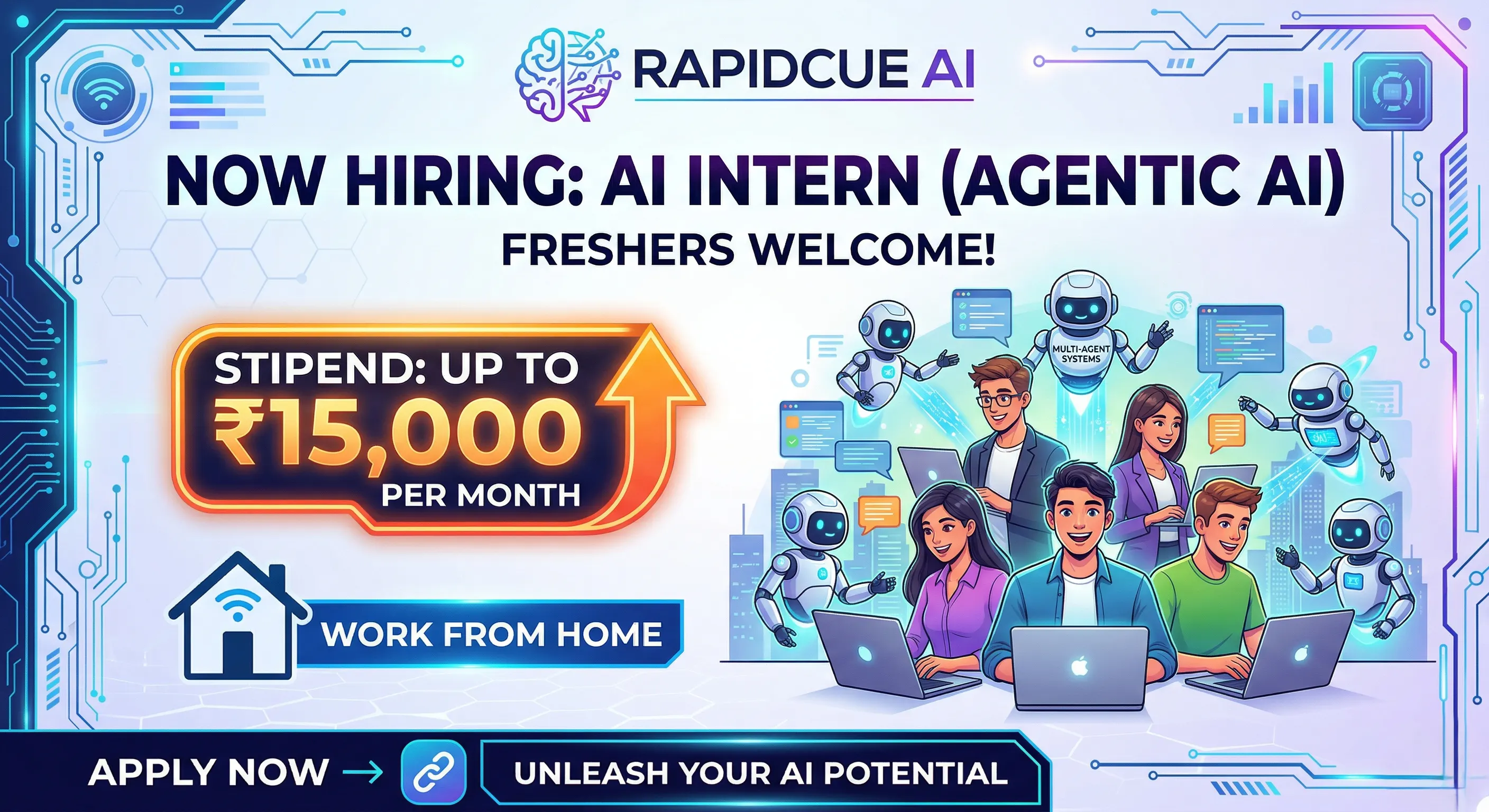
If you are actively searching for a real AI internship instead of generic "AI intern" listings that never explain actual work, this update deserves full attention. RapidCue AI is hiring freshers for AI Intern (Agentic AI) in a remote, part-time format, and the role description clearly points to practical implementation: LLM applications, workflow orchestration, RAG systems, vector search, and tool-using AI agents for business-facing use cases.
Most fresher applicants miss opportunities like this because they apply with broad buzzwords but no focused proof of skill. RapidCue's listing is a strong signal that they are not looking for theory-only candidates. They want learners who can build, test, improve, and reason through AI pipelines that work in real-time sales scenarios. That means your portfolio quality and problem-solving clarity matter more than fancy claims.
This guide follows the same humanized content structure as our top-performing Siemens and other fresher hiring blogs, but customized deeply for this role. You will get role highlights, qualification decoding, project ideas, preparation roadmap, resume strategy, and the official apply link in one place so you can move fast with confidence.
Table of Contents
- RapidCue AI Intern 2026: Quick Job Highlights
- About RapidCue AI and Why This Role Matters
- Role Description in Simple Practical Language
- Required Qualifications and Skill Breakdown
- Preferred Qualification Line You Should Not Ignore
- What Recruiters Usually Evaluate in Agentic AI Interns
- Portfolio Projects That Increase Selection Probability
- 14-Day Preparation Roadmap Before You Apply
- Resume and Cover-Letter Strategy for This Role
- Application Link and Final Takeaway
- Also Read
- FAQs
RapidCue AI Intern 2026: Quick Job Highlights
| Company | RapidCue AI |
| Role | AI Intern (Agentic AI) |
| Location | India (Remote) |
| Job Type | Part-time Internship |
| Apply Type | Easy Apply (LinkedIn) |
| Application Activity | Over 100 applicants |
| Posted | About 12 hours ago |
| Industry | Technology, Information and Internet |
| Company Size | 11-50 employees |
| LinkedIn Presence | 1 associated member listed on LinkedIn |
| Core Focus Areas | Agentic AI, LLM Apps, RAG, Vector Search, Prompt Engineering |
About RapidCue AI and Why This Role Matters
RapidCue AI positions itself as a real-time AI sales copilot and autopilot. In simpler terms, the company is building AI systems that can support live sales calls and also automate parts of interaction workflows when needed. This is important because most AI internships still revolve around isolated notebook experiments. Here, the role orientation is closer to business-impact systems where latency, response quality, consistency, and reliability all matter at once.
For freshers, this is a meaningful difference. When you work on agentic workflows in a sales-tech context, you are forced to think beyond model outputs. You start asking better engineering questions: how retrieval quality affects conversion, how tool calls should be validated, how prompts should evolve across multi-step flows, and how to handle failures without degrading user trust. These are exactly the practical skills that make a fresher profile stand out in 2026 AI hiring.
Another strong point is role timing. Since applicant volume is already high, profiles with concrete build evidence will naturally move ahead of profiles with only course certificates. If you can demonstrate one solid project in RAG + orchestration + prompt evaluation, your application quality improves immediately.
Role Description in Simple Practical Language
RapidCue's official role description includes development, testing, and deployment support for AI-driven systems and agentic workflows. Let us decode what this usually means in day-to-day tasks:
- Building LLM-powered components: You may prototype assistants for sales call guidance, objection handling, or context-aware response suggestions.
- Working on prompt design: You will likely iterate prompts for better response grounding, business tone consistency, and lower hallucination risk.
- Developing RAG pipelines: Expect tasks around chunking strategy, retrieval quality, reranking, and citation-aware generation.
- Handling vector search systems: You may evaluate FAISS, Pinecone, Weaviate, Chroma, Milvus, or similar tools based on use case constraints.
- Implementing tool-using agents: The role may involve building agent flows that call APIs, query knowledge, and execute defined steps safely.
- Testing reliability and accuracy: You may run evaluation loops, compare prompt versions, and measure response consistency under real scenarios.
- Orchestrating workflows: Intern contributions can include chaining tools and models into repeatable workflows using LangChain/LangFlow patterns.
- Research and optimization: You may benchmark models, tune retrieval logic, and suggest architecture changes for better outcomes.
This is why the role is valuable for serious AI learners. It combines prototyping with engineering discipline and business applicability. You are not only learning "how to generate text," you are learning how to build systems that organizations can trust in production-like conditions.
Required Qualifications and Skill Breakdown
The listing gives a broad qualification set, but here is the practical interpretation that helps you prepare better:
- Python proficiency: You should be comfortable writing modular scripts, API integrations, and basic backend logic.
- AI/ML framework familiarity: PyTorch, TensorFlow, and Hugging Face exposure improves your flexibility during experimentation.
- NLP and ML fundamentals: Concepts like embeddings, tokenization, model inference behavior, and evaluation metrics matter.
- LLM app framework familiarity: LangChain, LangFlow, and equivalent orchestration tools are directly relevant.
- RAG understanding: Retrieval-Augmented Generation design, chunking heuristics, and relevance tuning are key.
- Vector database awareness: FAISS/Pinecone/Weaviate/Chroma/Milvus familiarity is expected for semantic retrieval pipelines.
- Agentic workflow understanding: Multi-step reasoning, tool-calling logic, state passing, and guardrails are valuable.
- Prompt engineering basics: You should know how to design prompts for structured output and scenario-specific control.
- Algorithmic reasoning: Data structures, optimization logic, and evaluation discipline still matter in AI roles.
- Remote collaboration readiness: Clear communication and independent execution are essential in part-time remote work.
Do not get intimidated by the full list. Internship roles often expect working familiarity, not deep specialization in every single area. A realistic strategy is to build strength in Python + RAG + one vector DB + one orchestration tool and then showcase your learning curve clearly.
Preferred Qualification Line You Should Not Ignore
The posting also gives a powerful one-line preferred qualification: exposure to Hugging Face, LangChain, LangFlow, RAG pipelines, vector databases, semantic search, and agentic AI workflows. This is essentially a recruiter shortcut for shortlisting profiles quickly.
If your resume can show even one meaningful project touching most of these elements, your profile quality jumps significantly. For example: "Built a sales-assist RAG bot using LangChain + Chroma + reranking + tool-calling for CRM lookups." That single line can speak louder than ten generic skill bullets.
What Recruiters Usually Evaluate in Agentic AI Interns
Based on patterns across similar AI internships, recruiters often score fresher applicants on practical thinking dimensions, not only technical jargon:
- Problem framing: Can you convert a vague business objective into measurable AI tasks?
- Pipeline reasoning: Do you understand where retrieval, generation, and orchestration can fail?
- Evaluation mindset: Can you define quality checks beyond "it gave an answer"?
- Debugging behavior: How do you isolate prompt issues, retrieval misses, or tool-call errors?
- Communication clarity: Can you explain your architecture simply and honestly?
- Execution ownership: Do you complete tasks independently in a remote setup?
In interview discussions, structured answers usually perform best: context, action, decision, result, and what you improved in the next iteration. This proves maturity even when your experience level is early-stage.
Portfolio Projects That Increase Selection Probability
If you want to stand out in this RapidCue hiring drive, build small but complete projects instead of large unfinished repos. Here are high-impact project ideas aligned with the role:
1. Sales Objection Assistant using RAG
Create a retrieval-based assistant that answers objection patterns from a curated sales knowledge base. Show query rewriting, retrieval confidence, and citation output.
2. Tool-Calling Agent for CRM Simulation
Build an agent that can call mock tools such as lead score fetch, recent activity summary, and pricing lookup. Add guardrails for invalid tool responses.
3. Prompt Version Evaluation Dashboard
Compare prompt templates across sample sales conversations and score outputs on relevance, accuracy, and actionability. Even a lightweight dashboard can look highly practical.
4. Retrieval Optimization Experiment
Demonstrate chunking strategies, embedding model swaps, and reranker impact on top-k relevance. Recruiters appreciate candidates who can quantify improvements.
Each project should include a clean README with objective, architecture, stack, evaluation method, and known limitations. Honest limitation notes often increase credibility because they show engineering maturity.
14-Day Preparation Roadmap Before You Apply
Use this sprint plan if you want a role-matched application rather than a rushed submission:
- Day 1: Revise Python fundamentals and API handling patterns.
- Day 2: Build mini retrieval pipeline with basic embeddings and vector store.
- Day 3: Implement first prompt templates for role-play sales queries.
- Day 4: Integrate LangChain or LangFlow for orchestration.
- Day 5: Add tool-calling logic for one mock external function.
- Day 6: Create evaluation set and compare two prompt versions.
- Day 7: Improve retrieval quality using chunk tuning and reranking.
- Day 8: Add error handling, logging, and response traceability.
- Day 9: Prepare one concise architecture diagram and explanation notes.
- Day 10: Refine resume bullets to show measurable project outcomes.
- Day 11: Draft a personalized cover letter focused on role fit.
- Day 12: Practice technical storytelling for project walkthrough.
- Day 13: Mock interview for AI fundamentals + system reasoning.
- Day 14: Final profile review and apply with confidence.
Resume and Cover-Letter Strategy for This Role
Because this listing is promoted and already has strong applicant activity, generic resumes are filtered quickly. Use role-specific positioning:
- Headline: Mention AI intern focus with Agentic AI and RAG exposure.
- Skills section: Prioritize Python, LangChain/LangFlow, vector DB, RAG, prompt engineering.
- Projects section: Use impact-driven bullets with numbers where possible.
- Experience section: Mention automation, API integration, and evaluation workflows if available.
- Links: Ensure GitHub demos run and README files are complete.
For cover letters, avoid overusing motivational language. Keep it crisp: why this role, what you built, what outcome you produced, and what you can contribute in a remote part-time setting. Confidence with evidence beats confidence without proof.
Apply Here - RapidCue AI Intern (Agentic AI)
Final Takeaway
RapidCue AI hiring for AI Intern (Agentic AI) is one of the more relevant fresher opportunities for candidates who want practical exposure to modern LLM and agent systems. The role combines real implementation areas such as RAG pipelines, vector search, workflow orchestration, and tool-calling agents with remote flexibility and business-facing context.
If you prepare with structure, build one role-aligned project, and present your work honestly, you can compete strongly even with a high applicant pool. Focus on clarity, proof, and execution consistency. That is the profile pattern that gets noticed in serious AI hiring pipelines.
Important: availability, response insights, and hiring speed can change quickly. Verify the official listing and apply early once your profile is aligned.
Also Read
- Alacriti Hiring Freshers for Software Engineer Offering Up to 8 LPA
- Siemens Healthineers Hiring Freshers for Technical Intern in Bangalore
- Zensar Hiring Freshers for AI Engineer in GEN AI Projects
- Atlas AI Hiring Freshers for AI/ML Intern 2026
- Predictive Data Sciences Hiring Freshers for Junior AI Builder
- CloudSEK Hiring Freshers for SDE Intern Frontend in Bengaluru
- Microsoft Hiring Freshers for Research Sciences Intern 2026
- Tektronix Hiring Freshers for SDE Intern in Bengaluru (Hybrid)
- Stadium Is Hiring Freshers for Software Engineer Intern Work From Home
- CloudEagle.ai Hiring Freshers for Associate Java Developer (Intern-to-Hire)
FAQs
1. Is this RapidCue AI internship open for freshers?
Yes. The role is fresher-friendly and suitable for students or recent graduates with practical AI project exposure.
2. Is the role full-time or part-time?
The listing indicates this is a part-time internship role.
3. Is this job remote?
Yes, the job is marked remote for candidates in India.
4. Which stacks should I prioritize before applying?
Focus on Python, LLM app frameworks (LangChain/LangFlow), RAG pipelines, vector search systems, prompt engineering, and workflow orchestration.
5. Are vector databases mandatory?
Practical familiarity with at least one vector DB is strongly recommended since semantic retrieval is central to the role.
6. What kind of projects improve selection chance?
Projects with agent workflows, retrieval quality evaluation, and business-use-case logic usually make a stronger impression than generic chatbots.
7. Do I need prior industry experience?
Prior industry experience is a plus, but well-executed projects and role-aligned fundamentals can still make your profile competitive.