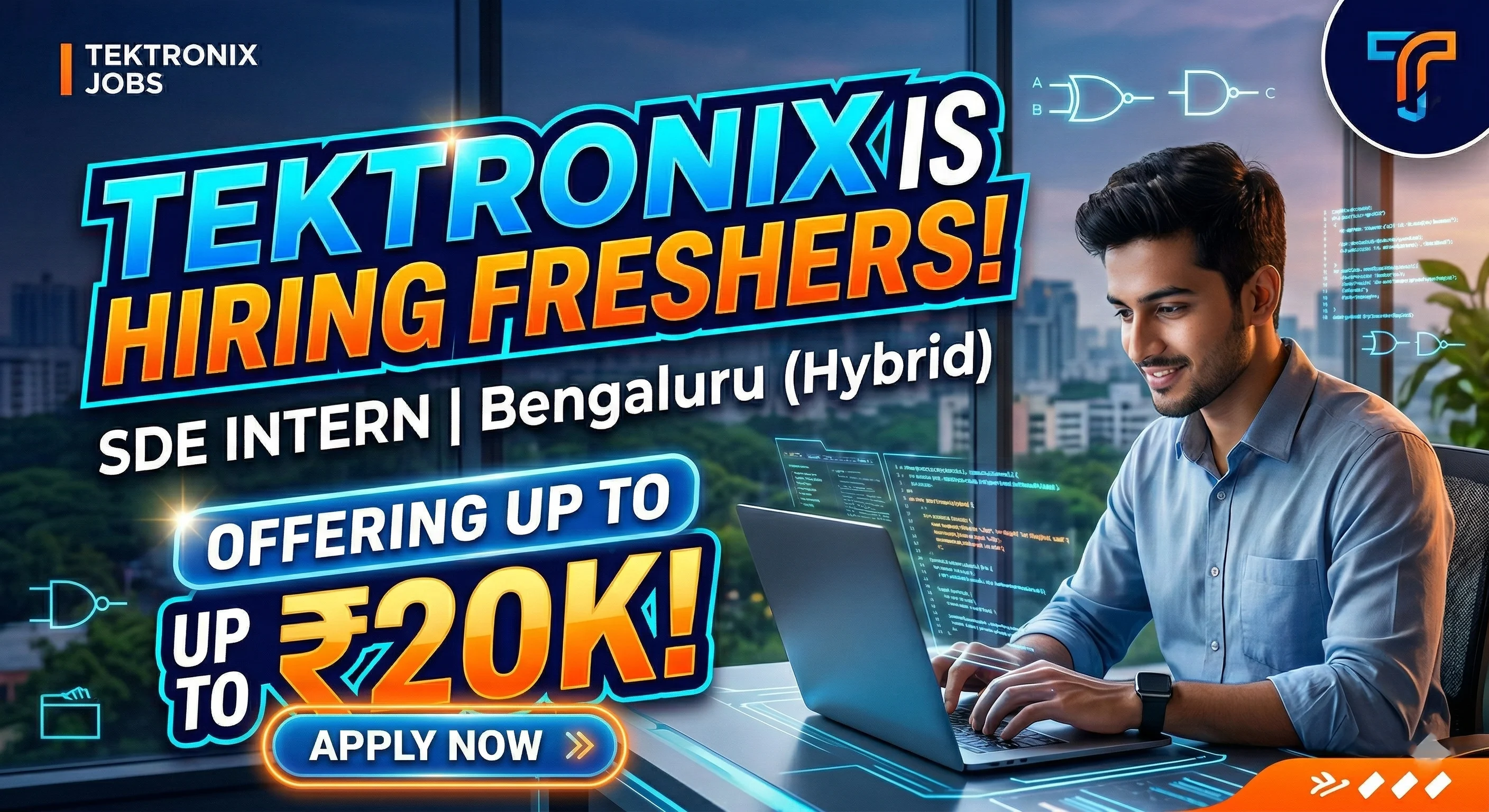
If you were waiting for a serious engineering internship in a respected product-tech ecosystem, this is one of the most important fresher opportunities right now. Tektronix is hiring freshers for SDE Intern in Bengaluru (Hybrid), and the role is attracting attention because it blends core software engineering skills with practical exposure to instrumentation-grade technology environments.
Most internship posts online just throw a job link and leave you confused. This guide is different. Here, you will get a complete breakdown of the role, eligibility, skill expectations, what interviewers usually check, and how to apply smartly without making common mistakes. If you are serious about starting your software career in 2026, read this fully before you apply.
Table of Contents
- Tektronix SDE Intern 2026: Job Highlights
- Role Snapshot and What Makes It Valuable
- Eligibility Criteria (Explained in Simple Words)
- Key Responsibilities and Day-to-Day Work
- Technical Skills Recruiters Will Evaluate
- AI/ML/GenAI Requirement: What It Means
- About Ralliant and Tektronix
- How to Prepare for the Interview
- Resume Checklist for Better Shortlisting
- How to Apply (Direct Link)
- Also Read
- FAQs
Tektronix SDE Intern 2026: Job Highlights
| Company Name | Tektronix (Wholly owned subsidiary of Ralliant Corporation) |
| Role | SDE Intern |
| Job ID | 8900 |
| Location | Bengaluru East, Karnataka, India |
| Work Mode | Hybrid |
| Employment Type | Internship |
| Eligible Degrees | BTech/BE, MTech/ME (aligned branches) |
| Eligible Branches | CSE, Information Science, DS, AI, EEE, ECE, Instrumentation, and aligned branches |
| Core Skills Asked | OOP, RTOS, programming, problem solving, Git, SDLC, communication, teamwork |
| Extra Preferred Exposure | AI/ML/GenAI technologies |
Role Snapshot and Why This Internship Is Worth Your Attention
Many fresher internships are limited to repetitive maintenance tasks. This one appears more meaningful because Tektronix sits in a high-impact engineering ecosystem where software supports real-world measurement and precision technology workflows. That means your code can connect to real tools, real systems, and real product outcomes, not just internal demo dashboards.
The company has specifically asked for candidates who understand object-oriented programming, have exposure to operating systems concepts like RTOS, and can work across multiple technology stacks. This suggests the role may involve practical software problem solving across backend logic, device-facing workflows, automation, and possibly test engineering support.
For freshers, this matters a lot. Early career growth is faster when you learn software engineering discipline in a system-driven environment: writing maintainable code, understanding constraints, collaborating with cross-functional teams, and communicating clearly when trade-offs are involved. This internship can offer that foundation if you approach it seriously.
Eligibility Criteria and Qualifications (Simple Explanation)
The official listing mentions the following qualification pathways:
- BTech/BE: CSE, Information Science, Data Science, AI, EEE, ECE, Instrumentation, or aligned engineering branches.
- MTech/ME: Computer Science, Electronics, or aligned higher-degree branches.
What this means in practical terms is that they are open to both software-first and electronics-aligned candidates, provided you have strong coding and problem-solving capability. So if you are from ECE/EEE/Instrumentation but you built projects in software, do not self-reject.
Also note the application flow shows options like resume upload and profile match check. In these systems, resume quality directly impacts screening. A generic resume with only course names and no project outcomes usually performs poorly. Make your skills demonstrable through project bullets and measurable impact lines.
Key Requirements Mentioned in the Listing
Here is the original requirement intent broken down in recruiter language:
- Good understanding of OOP and RTOS: You should know classes, objects, abstraction, encapsulation, plus basic real-time execution ideas like scheduling and timing sensitivity.
- Language proficiency: You should be comfortable in at least a few technologies among .NET, C#, Angular, C, C++, Java, Python, Oracle/SQL, and Selenium.
- Exposure to AI/ML/GenAI: Not necessarily advanced research depth, but working familiarity is expected.
- Problem-solving skills: You must show structured thinking, not just syntax memorization.
- Interpersonal and communication skills: You should explain your approach clearly in written and verbal formats.
- Team collaboration: Ability to work respectfully with peers and stakeholders is important.
- Version control basics: Git fundamentals are expected.
- SDLC understanding: You should know how software moves from requirement to release.
- Ownership and time management: Ability to manage tasks, ask for help at the right time, and complete work without excessive hand-holding.
- Learning mindset: Willingness to adapt and upskill quickly.
What You Might Actually Work On as an SDE Intern
Job descriptions are often short, but practical work can be broader. Based on the skill stack and company profile, your day-to-day may include:
- Writing or improving modules in one primary language (for example C++, Python, or C#) and integrating with existing systems.
- Supporting internal tools, testing pipelines, or automation tasks using SQL/Selenium and scripting.
- Working with feature tickets, debugging defects, and documenting fixes with reproducible test notes.
- Collaborating with cross-functional teams where software, hardware, and test engineering intersect.
- Using Git for branch workflows, code reviews, and version-safe collaboration.
- Contributing to quality discussions around code maintainability, reliability, and execution behavior.
You may not own architecture decisions as an intern, but you will likely be expected to execute assigned tasks cleanly, communicate blockers early, and show fast learning velocity. Recruiters usually prioritize these habits over flashy but shallow tool exposure.
AI/ML/GenAI Exposure: How to Interpret This Requirement
Many students panic when they see AI/ML/GenAI in a JD. In most fresher roles, this does not mean you need to publish research papers. It usually means you should understand fundamentals and show practical use cases.
A strong answer in interview could be: you used an LLM assistant to generate test cases, summarize logs, improve documentation quality, or prototype edge-case handling, while still manually validating outputs. This shows real engineering judgment. Blind copy-paste without validation is a negative signal.
If you want to prepare quickly, keep one mini AI project ready, such as:
- A simple classifier or regression notebook with clean preprocessing steps.
- A GenAI-based FAQ assistant with prompt constraints and evaluation logs.
- An automation script that uses AI for issue categorization with manual review checkpoints.
About Ralliant Corporation and Tektronix
The listing highlights that Ralliant, originally part of Fortive, now operates as an independent public company focused on precision technology innovation. The message is clear: this is a technology-led environment where engineers are expected to solve hard real-world problems and ship reliable solutions.
Tektronix, as a wholly owned subsidiary of Ralliant, is described as a workplace where teams push boundaries and build precision-engineered measurement solutions that help customers move from idea to realization faster. That positioning usually aligns with high technical standards, cross-domain collaboration, and process maturity.
Another notable point in the official messaging is inclusion and diversity. The company explicitly emphasizes belonging and equal opportunity practices, and also mentions accommodation support for candidates with disabilities. For many applicants, this is an important factor when evaluating long-term career growth and work culture quality.
How to Prepare Smartly for Tektronix SDE Intern Interview
If you want practical preparation instead of random topic lists, follow this compact roadmap:
1) Strengthen one primary language deeply
Pick one among C++, Java, Python, or C# and become interview-ready in syntax, OOP design, debugging, and clean coding practices.
2) Revise OOP and systems basics
Be ready to explain abstraction, inheritance, interfaces, object lifecycle, and practical memory/runtime considerations.
3) Solve problem-solving questions daily
Practice arrays, strings, hashing, recursion, and basic dynamic programming with complexity discussion.
4) Prepare one strong end-to-end project
Your project explanation should include problem statement, architecture, trade-offs, bugs faced, fixes, and measurable results.
5) Learn Git and workflow hygiene
Know branching, commit messages, pull request flow, and conflict resolution basics. Interviewers often ask this.
6) Keep one AI/ML/GenAI use-case ready
Demonstrate a realistic workflow where AI improved productivity while you ensured human validation.
7) Practice communication
If your explanation is clear and structured, your technical answers appear stronger. Speak in short, logical steps.
Resume Checklist to Improve Shortlisting Rate
- Add a clear headline: degree, graduation year, preferred role (SDE Intern), and location readiness.
- Keep skills section honest and interview-defendable.
- Mention projects with impact metrics such as reduced runtime, improved accuracy, or automation gain.
- Add GitHub links with readable README and setup instructions.
- Highlight teamwork instances from internships, hackathons, or group projects.
- Include AI/ML/GenAI exposure in one line with practical context.
- Avoid overstuffed buzzwords and keep formatting ATS-friendly.
Common Mistakes Freshers Should Avoid
- Applying with a generic resume that does not match the JD keywords.
- Claiming many languages but failing to solve basic coding questions in one language confidently.
- Ignoring OOP and SDLC questions while over-focusing only on DSA.
- Not preparing project deep-dives (design choices, bugs, debugging approach).
- Giving AI-generated sounding answers without personal context or practical examples.
- Poor communication of assumptions, blockers, and trade-offs.
How to Apply for Tektronix SDE Intern (Job ID 8900)
Interested and eligible candidates can apply using the direct official listing link below:
Before applying, make sure your resume reflects the exact requirement pattern: OOP, problem solving, Git, SDLC, communication, and AI/ML/GenAI exposure. This alignment significantly improves shortlist probability.
Final Takeaway
Tektronix hiring for SDE Intern in Bengaluru (Hybrid) is a strong opportunity for freshers who want a serious engineering start in 2026. The requirement pattern is practical: strong fundamentals, multi-language adaptability, collaborative behavior, and learning mindset. This is exactly the profile many top product teams look for in early-career talent.
If your fundamentals are clear and your projects are real, you can be a competitive applicant even without years of experience. Focus on clarity, execution discipline, and honest problem-solving ability. Those three things consistently separate shortlisted candidates from the rest.
Also Read
- CloudSEK Hiring Freshers for SDE Intern - Frontend in Bengaluru
- Razorthink Hiring Freshers for Trainee Software Engineers in Bangalore
- Deltek Hiring Freshers for Associate Software Engineer in Bangalore
- DigiDxDoc Hiring Freshers for Frontend Developer Intern (Paid + PPO)
- Black March Studios Hiring Freshers for Web Development Intern (WFH)
- CloudEagle.ai Hiring Freshers for Associate Java Developer (Intern-to-Hire)
- Codemonk Hiring Freshers for Software Engineering Intern in Bengaluru
- Unisys Hiring Student Tech Intern 2026/2027 in Bangalore
- Atlas AI Hiring Freshers for AI/ML Intern 2026
FAQs
1. What is the location for Tektronix SDE Intern role?
The location mentioned is Bengaluru East, Karnataka, India.
2. Is this Tektronix internship hybrid or full onsite?
The role is listed as hybrid.
3. Which branches are eligible?
BTech/BE in CSE, Information Science, DS, AI, EEE, ECE, Instrumentation, and aligned branches. MTech/ME aligned branches are also mentioned.
4. Is AI/ML/GenAI knowledge mandatory?
The listing asks for exposure to AI/ML/GenAI technologies, so practical familiarity is strongly beneficial.
5. Which programming languages should I prepare?
Prepare at least one language deeply, and be comfortable with a few among C, C++, Java, Python, C#, SQL, or related tools listed in the JD.
6. Is knowledge of Git and SDLC important for this role?
Yes. Basic version control with Git and familiarity with SDLC concepts are explicitly listed requirements.
7. What is the direct application link?
You can apply through this official listing: https://www.linkedin.com/jobs/view/4378759708/
8. What is the Job ID for this internship?
The job listing shows Job ID 8900.