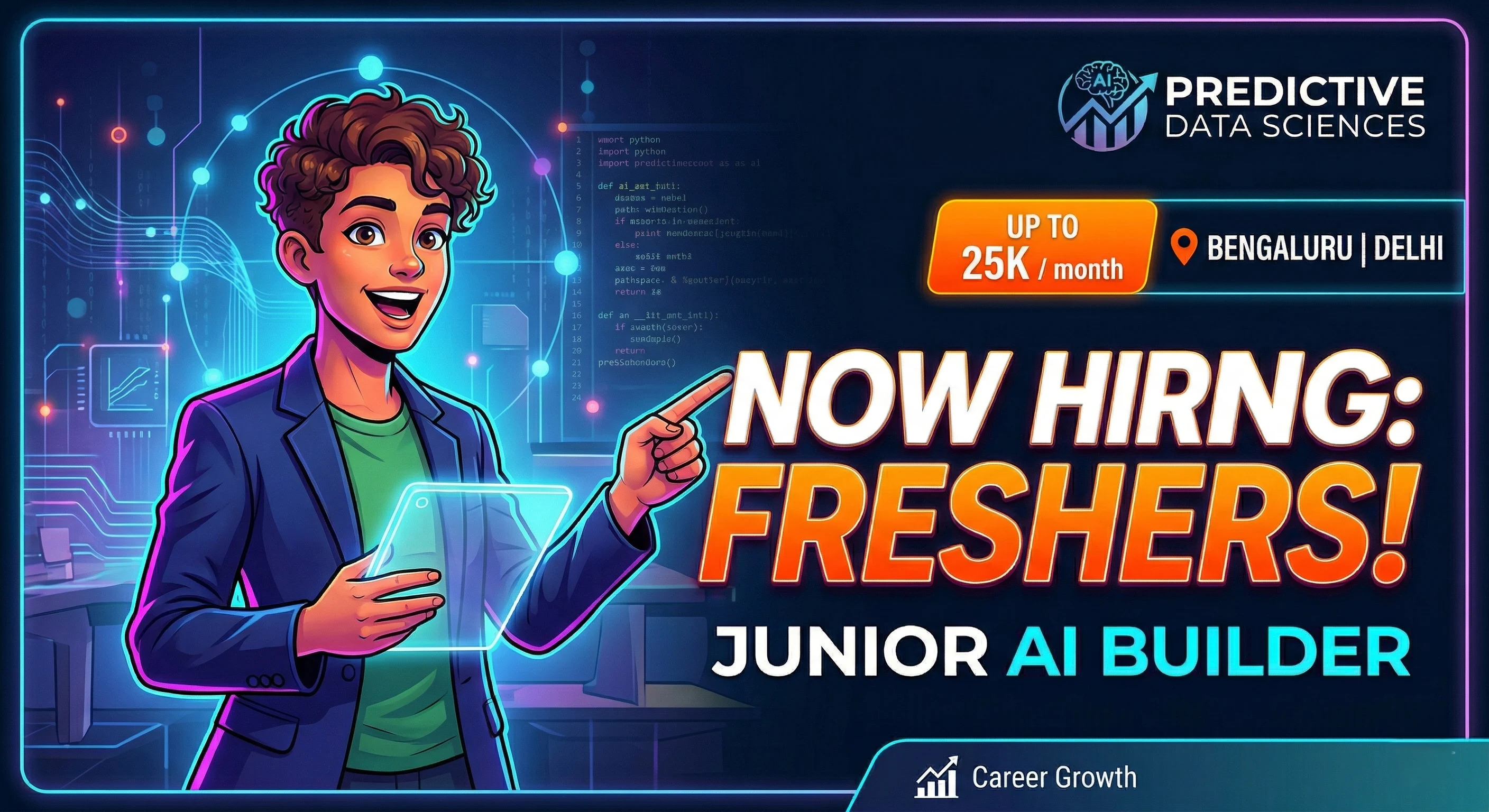
If you are searching for a real AI role where your coding, debugging, and product thinking matter from day one, this is one of the strongest fresher opportunities currently open in India. Predictive Data Sciences is hiring freshers for Junior AI Builder, and this role is very different from generic "AI intern" posts that only involve surface-level prompt writing.
The company is looking for builders who can write Python, work with modern LLM tooling, test what fails, and improve systems until they become actually useful for business teams. In simple words, this is a role for people who like building working systems, not only explaining theory. If you want to grow in applied AI engineering, this guide will help you evaluate fit, prepare correctly, and apply with a stronger profile.
In this article, we are following the same high-clarity structure used in our most-read hiring guides. You will get job highlights, role expectations, skills checklist, interview preparation path, resume strategy, and direct apply link in one place.
Table of Contents
- Predictive Data Sciences Junior AI Builder: Job Highlights
- Role Overview in Simple Language
- What You Will Work On (Real Task Breakdown)
- Skills Required to Get Shortlisted
- Strong Signals Recruiters Look For
- Location, Experience, and Work Setup
- How to Prepare for Junior AI Builder Interviews
- Resume Strategy and Portfolio Checklist
- Mistakes Freshers Should Avoid
- How to Apply (Direct Link)
- Also Read
- FAQs
Predictive Data Sciences Junior AI Builder: Job Highlights
| Company Name | Predictive Data Sciences |
| Role | Junior AI Builder |
| Experience Required | 0 - 2 years |
| Location | Mumbai, Delhi NCR, Bengaluru (plus multi-city/remote mention in role text) |
| Work Mode | Location-flexible depending on business need and assignment |
| Employment Type | Full Time, Permanent |
| Department | Data Science and Analytics |
| Industry Type | Analytics / KPO / Research |
| Core Stack Mentioned | Python, LLM APIs, prompting, retrieval, embeddings, evals, fine-tuning, tool-use workflows |
| Compensation | Not disclosed publicly |
Role Overview in Simple Language
The hiring note from Blue Sherpa (team context shared in the JD) says this clearly: the company builds AI systems for lenders and credit funds so risk teams can move faster from signal to decision. This means the role is close to real business outcomes, where model behavior, data quality, and workflow design affect how financial teams act.
It is also clearly not a pure research role and not a no-code automation role. The company wants junior applied AI builders who can code, debug, test assumptions, and improve systems incrementally. If you are someone who likes hands-on building more than PPT-level AI discussion, this role is aligned with your profile.
A big advantage for freshers here is ownership exposure. The JD says you will own small problems end-to-end while working with experienced practitioners. That is exactly the type of work that accelerates career growth in AI engineering.
What You Will Work On (Real Task Breakdown)
Here is the role responsibility list translated into practical day-to-day work:
- Build LLM-powered workflows: You may design systems for document understanding, risk memo generation, underwriting summaries, or credit ops support.
- Work with prompting and structured outputs: You will likely define schemas, output contracts, and guardrails for production reliability.
- Use retrieval and embeddings: Expect retrieval pipelines and context assembly to improve factuality and domain relevance.
- Design evals: You will measure where systems fail, then improve prompts, data flow, retrieval, or model choices based on evidence.
- Debug real-world failures: This includes prompt drift, wrong tool calls, malformed outputs, stale context, data quality issues, and logic bugs.
- Build end-to-end prototypes: Simple internal tools, pilot pipelines, and production-adjacent workflows are part of the role.
- Solve ambiguous business problems: You must translate unclear stakeholder ask into a clear technical first version.
Notice the pattern: this role rewards practical builders who can iterate quickly and responsibly, not candidates who only memorize AI buzzwords.
Skills Required to Get Shortlisted
The job highlights two priorities: strong coding in Python and comfort with today’s AI stack. Let us break that down into interview language:
1) Strong coding ability in Python
You should be able to write modular, testable, debuggable code. Interviewers often evaluate whether you can structure code cleanly, not just make it work once.
2) Meaningful exposure to modern AI building blocks
The listing explicitly mentions:
- LLM APIs and workflows
- Prompting and structured generation
- Embeddings and retrieval
- Evals
- Fine-tuning (nice signal, not mandatory depth)
- Tool use or agent-style workflows
You are not expected to be deep expert in every item, but you should be able to discuss trade-offs and decisions in at least a couple of real projects.
3) Builder mindset
The JD repeatedly emphasizes building outside assignments and making progress independently. This is a major screening differentiator in applied AI hiring.
4) Debugging instinct
A strong signal is your ability to explain what failed, how you diagnosed it, and what you changed. This is exactly how real AI systems are improved in production teams.
Strong Signals Recruiters Look For
The listing clearly defines what helps candidates stand out. Build your profile around these signals:
- GitHub or equivalent portfolio: Not empty repo dumps, but meaningful projects with clear README and architecture notes.
- Working AI systems you can explain: If your project is runnable and you can explain design choices, you gain credibility quickly.
- Project depth over count: One good RAG or eval-heavy project is often better than five shallow clones.
- Evidence of independent work: Side projects, freelancing, contributions, or self-initiated tools are strong positives.
- Failure stories: Teams trust candidates who can explain real failures and thoughtful fixes.
Nice-to-Have Stack (From Listing + Industry Reality)
The role also mentions additional technologies that can strengthen your profile:
- RAG and retrieval-based workflows
- Hugging Face, PyTorch, or TensorFlow familiarity
- FastAPI or Flask for service endpoints
- Cloud and data pipeline exposure
- Analytics, credit, or risk-domain understanding
What This Role Is Not (Very Important)
The company explicitly clarifies the scope to avoid confusion:
- Not pure ML research
- Not a generic data analyst profile
- Not only prompt engineering
- Not no-code automation
This is a cross-functional AI builder position at the intersection of engineering, AI systems, and business workflows. Keep that framing in your interview answers.
Location, Experience, and Work Setup
From the job details provided, this opening is listed for 0 to 2 years experience and mentions Mumbai, Delhi NCR, and Bengaluru as primary locations. Another section also references wider city coverage such as Chennai, Pune, Kolkata, Ahmedabad, Hyderabad, and remote availability depending on project context.
Compensation is marked as not disclosed, which is common in early-stage AI hiring where pay depends on capability fit, project depth, and interview strength. Rather than guessing salary, focus on maximizing offer quality through a strong proof-of-work portfolio and structured interview performance.
How to Prepare for Junior AI Builder Interviews
If you are applying this week, use this practical 10-day preparation strategy:
Day 1-2: Build one clean LLM workflow project
Create a mini workflow with user input, retrieval, structured JSON output, validation checks, and error logging. Keep architecture simple and explainable.
Day 3-4: Add evals and failure analysis
Define test cases, collect failure modes, and document improvements. This directly maps to the role expectation of designing evals and improving systems.
Day 5: Strengthen Python quality
Refactor your code into modules, add docstrings, basic unit tests, and clear naming conventions. Interviewers notice code hygiene.
Day 6: Retrieval and embeddings revision
Understand chunking, vector search basics, reranking ideas, context window trade-offs, and hallucination reduction patterns.
Day 7: API and deployment basics
Expose your workflow through FastAPI or Flask endpoint and test request/response behavior with sample payloads.
Day 8: Debugging drill
Simulate wrong outputs, broken schema, token limits, and retrieval misses. Prepare root-cause explanations.
Day 9: Communication and business mapping
Practice explaining your project to both technical and non-technical audiences. Connect your work to business outcomes like speed, quality, or risk reduction.
Day 10: Mock interview + resume finalization
Do one coding mock, one system walkthrough, and one behavior round focused on ownership, ambiguity handling, and independent learning.
Resume Strategy and Portfolio Checklist
- Use headline like: Junior AI Builder | Python | LLM Workflows | Retrieval | Evals.
- Add 2-3 project bullets with outcome metrics such as latency reduction, accuracy lift, or process-time improvement.
- Show one failure-debug-improvement story in project description.
- Include GitHub links where README explains setup, architecture, and known limitations.
- Mention tools you actually used: OpenAI/Anthropic APIs, vector DB, FastAPI, Flask, PyTorch, etc.
- Keep skills truthful. Interview rounds quickly detect inflated claims.
- Add availability and location flexibility clearly.
Common Mistakes Freshers Should Avoid
- Treating this role like a basic chatbot prompt role.
- Submitting resumes with no working project links.
- Talking only about models, not about data flow, evals, and production constraints.
- Skipping debugging prep and failing to explain failure diagnosis.
- Using copied portfolio projects that cannot be defended in interview.
- Giving vague answers without measurable outcomes.
How to Apply for Predictive Data Sciences Junior AI Builder
Interested and eligible candidates can apply using the direct official listing link below:
Before applying, make sure your resume and project links directly reflect the requirements: Python depth, LLM workflow experience, retrieval/eval understanding, and evidence of debugging-driven improvement.
Final Takeaway
Predictive Data Sciences Junior AI Builder hiring is one of the better applied-AI opportunities for freshers because it emphasizes real system building, not surface-level AI usage. The role expects coding depth, practical experimentation, and the maturity to debug and iterate on ambiguous problems.
If you can show one or two meaningful AI projects with clear architecture, evaluation method, and failure analysis, you can stand out strongly even at 0-2 years experience level. In this hiring pattern, proof of building ability beats theoretical knowledge alone.
Also Read
- Tektronix Hiring Freshers for SDE Intern in Bengaluru (Hybrid)
- Know Why You Are Not Getting Shortlisted, Even After Applying to Many Companies
- CloudSEK Hiring Freshers for SDE Intern - Frontend in Bengaluru
- Razorthink Hiring Freshers for Trainee Software Engineers in Bangalore
- Deltek Hiring Freshers for Associate Software Engineer in Bangalore
- DigiDxDoc Hiring Freshers for Frontend Developer Intern (Paid + PPO)
- Black March Studios Hiring Freshers for Web Development Intern (WFH)
- CloudEagle.ai Hiring Freshers for Associate Java Developer (Intern-to-Hire)
- Codemonk Hiring Freshers for Software Engineering Intern in Bengaluru
- Unisys Hiring Student Tech Intern 2026/2027 in Bangalore
FAQs
1. Who can apply for Predictive Data Sciences Junior AI Builder role?
As per the listing, freshers and early-career candidates with 0 to 2 years of experience and strong practical AI coding skills can apply.
2. Is this role focused only on prompt engineering?
No. It is a builder role involving coding, retrieval, evaluation design, debugging, and end-to-end workflow development.
3. Which skills are most important for shortlisting?
Python coding depth, LLM APIs, structured outputs, retrieval/embeddings, evals, debugging mindset, and practical problem-solving ability are key.
4. Is prior experience mandatory for this role?
The listing shows 0 to 2 years, so freshers with strong project work and proof of building can compete well.
5. What are the listed work locations?
Mumbai, Delhi NCR, and Bengaluru are listed prominently, with extended city/remote mention in detailed role text.
6. Which frameworks are useful to know?
FastAPI/Flask, Hugging Face, PyTorch or TensorFlow, and data pipeline basics can strengthen your profile though not all are mandatory.
7. What kind of projects should I add in my resume?
Add projects where you built working LLM systems, show eval methods, explain failures, and describe what you improved.
8. What is the direct apply link for this role?
You can apply through the official listing link included in the Apply here section above.