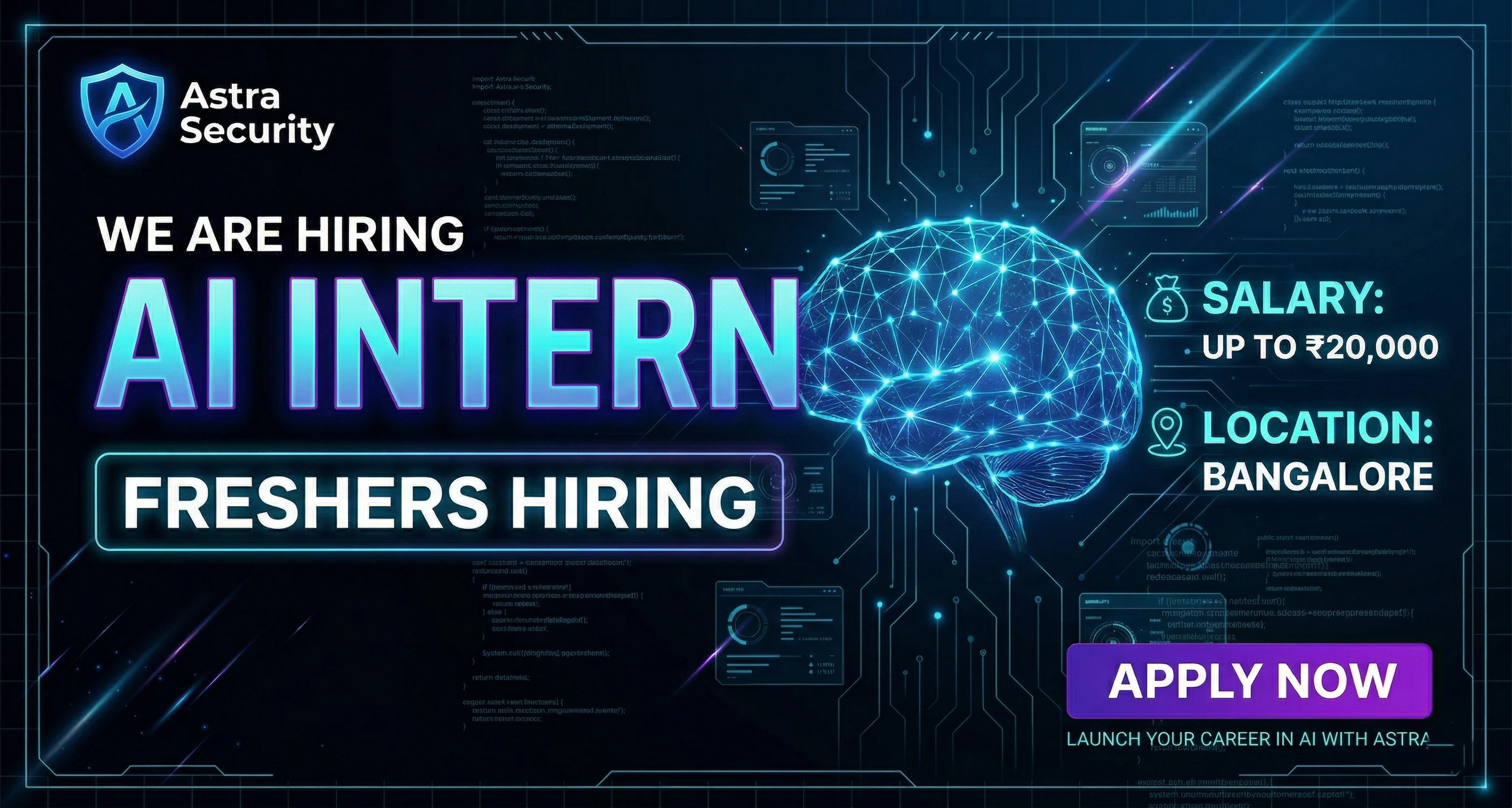
If you have been searching for a fresher AI internship where your work goes beyond demo chatbots, this is one of the strongest opportunities currently open. Astra Security is hiring freshers for AI Engineer Intern in a hybrid Bengaluru setup for six months. The role is designed for candidates who can build, ship, and iterate practical AI systems, not just experiment with prompts in isolation.
What makes this opening stand out is context. You are not entering a generic AI team where impact is hard to measure. You will work inside a cybersecurity product used by hundreds of businesses globally, where every improvement in retrieval quality, agent reliability, and model integration can directly improve vulnerability discovery speed and security outcomes. For freshers, this is exactly the kind of environment that builds real engineering maturity fast.
In this full guide, we are using the official job details and expanding them into practical, interview-ready insights. You will find role highlights, expected skills, what hiring managers usually evaluate in AI intern interviews, and a realistic preparation plan you can follow before applying.
Table of Contents
- Astra Security AI Engineer Intern: Quick Highlights
- About Astra Security and Why This Role Matters
- Role Overview in Real Product Terms
- What You Will Build: LLM Apps, RAG, and Agents
- Tools and Tech Stack Explained for Freshers
- Eligibility and Profile Match Checklist
- How to Build a Shortlist-Worthy AI Portfolio
- 30-Day Smart Preparation Plan
- Application Strategy, Resume Tips, and Interview Path
- Perks, PPO Scope, and Career Value
- Technical Interview Topics You Should Prepare
- Common Mistakes That Reduce Shortlist Chances
- Official Apply Link and Final Checklist
- Also Read
- FAQs
Astra Security AI Engineer Intern: Quick Highlights
| Company | Astra Security |
| Role | AI Engineer Intern |
| Location | Hybrid - Bengaluru (in-office collaboration expected) |
| Duration | 6 Months |
| Work Focus | AI applications, RAG systems, agentic workflows, backend integrations |
| Core Languages | Python or TypeScript |
| Framework Exposure | LangGraph, Mastra, CrewAI or similar |
| Ideal Candidate | Final-year student or recent graduate with at least one AI project |
| Selection Stages | Initial screening call and technical interview |
| Application Mode | LinkedIn job listing |
About Astra Security and Why This Role Matters
Astra Security operates in cybersecurity SaaS and is known for making security testing continuous, scalable, and actionable. Its AI-led pentest platform and vulnerability scanner are designed to simulate real attack behavior, helping teams secure applications faster than traditional periodic testing approaches.
The company reports operating at meaningful scale: 13,000 plus tests in its scanner workflow, trust from 800 plus companies across 70 plus countries, and millions of vulnerabilities identified. Whether you are applying from a college campus or after graduation, this scale matters because your internship effort does not remain theoretical. You get direct exposure to production-grade workflows and customer-facing impact.
This is also one of the few fresher AI roles where cybersecurity context is not optional noise. It is central to the product. That gives you an edge later when you apply for AI engineering, security automation, or platform roles, because you can demonstrate work in a high-stakes domain where accuracy, reliability, and traceability are critical.
Role Overview in Real Product Terms
The posting describes a technically strong and product-driven intern profile. In plain terms, Astra is looking for someone who can convert AI ideas into shippable features. This usually includes building internal tools, improving retrieval quality, connecting LLM outputs with backend APIs, and validating that the system behaves consistently under real usage patterns.
Unlike assignment-style internships, product-driven internships require ownership. You may start with a narrow problem statement, but over time you are expected to ask better questions: is the retrieval context enough, is tool calling reliable, are prompts reproducible, are edge cases covered, and does latency remain acceptable for user-facing flows.
If that sounds challenging, that is exactly why this internship can accelerate your profile. You do not just learn model names. You learn system thinking around LLM applications, from user query to context retrieval to response generation to measurable product behavior.
What You Will Build: LLM Apps, RAG, and Agents
The job details mention four key execution areas. Here is what they usually look like in day-to-day engineering:
- AI application development: building practical LLM-powered flows with APIs from OpenAI, Anthropic, or open-source models. This can include generation features, analyst-assist features, triage helpers, and task copilots.
- RAG and knowledge systems: creating pipelines that ingest internal docs or platform knowledge, convert them to embeddings, index vectors, and retrieve relevant context before generation.
- Agentic workflows: implementing multi-step systems where an agent can plan, call APIs, use tools, gather evidence, and produce structured outcomes instead of one-shot text output.
- Engineering and platform integration: exposing AI features through backend services, adding guardrails, writing clean code, using Docker for portability, and maintaining delivery hygiene with Git and CI basics.
A practical way to interpret this is: Astra wants interns who can build complete loops, not isolated scripts. You should be comfortable moving between prompt logic, API interfaces, data flow, and debugging.
Tools and Tech Stack Explained for Freshers
The stack listed in the posting is modern and industry-aligned. Here is how to prioritize it:
- Python or TypeScript: pick one as your primary language and become dependable with it. If your current strengths are mixed, choose Python for faster AI prototyping and TypeScript for strong integration habits in web stacks.
- LangGraph or similar frameworks: learn stateful workflow design, conditional branching, and tool execution reliability.
- Vector databases: understand how FAISS, PGVector, Pinecone, or Weaviate store embeddings and serve similarity search.
- LLM providers: know differences in context windows, quality, latency, and cost implications across OpenAI, Anthropic, Llama, and Mistral.
- Docker, Git, CI basics: these are non-negotiable for collaborative product teams and will strongly influence your interview performance.
- AWS or GCP basics: even basic cloud familiarity helps when discussing deployment, security boundaries, and service integration.
Freshers often panic when they see many tools. You do not need mastery in all of them. You need one strong end-to-end project that demonstrates judgment and execution using a subset of this stack.
Eligibility and Profile Match Checklist
The role is aligned to final-year students and recent graduates in CS, AI, or related disciplines. A degree alone is not enough. Astra is explicitly looking for hands-on evidence. Use this checklist before applying:
- You have built at least one AI project, preferably a RAG app, chatbot, or agent workflow.
- You can explain LLM behavior in simple terms: context, prompts, retrieval, hallucinations, and output constraints.
- You are comfortable coding in Python or TypeScript without heavy copy-paste from tutorials.
- You are curious and practical, willing to test, fail, and improve systems based on feedback.
- You are open to hybrid work in Bengaluru and can commute when required.
Nice-to-have signals that may improve shortlist chances include vector database experience, prior usage of agent frameworks, and a visible interest in cybersecurity.
How to Build a Shortlist-Worthy AI Portfolio
Most applicants now mention AI projects, but many project repos are shallow. To stand out, your project should prove decision-making quality. A better portfolio project for this role could be:
- A security knowledge assistant that retrieves from CVE summaries, policy docs, and incident runbooks.
- An agent that triages vulnerability reports by severity and recommends remediation next steps.
- A support copilot that reads product docs and generates responses with citations from retrieved context.
For each project, add three things most candidates skip: architecture diagram, evaluation notes, and failure analysis. Mention where retrieval failed, how you fixed chunking or reranking, and how prompt changes affected consistency. This creates trust because interviewers can see engineering depth instead of polished marketing language.
Also ensure your README is useful. It should include setup steps, sample inputs, model choices, cost trade-offs, and known limitations. A readable repo is often the difference between a callback and a rejection in early screening.
30-Day Smart Preparation Plan
If you want to apply soon but improve quality quickly, use this 30-day plan:
- Day 1-4: revise Python or TypeScript fundamentals, API handling, asynchronous calls, and debugging basics.
- Day 5-9: build a baseline LLM app with prompt templates, retries, and logging.
- Day 10-15: add a RAG pipeline with chunking, embeddings, vector index, and citation-aware responses.
- Day 16-20: implement a simple agentic flow with tool calls and multi-step task execution.
- Day 21-24: containerize using Docker and document setup for reproducibility.
- Day 25-27: add tests for core logic and create basic evaluation metrics for response quality.
- Day 28-30: refine resume bullets around outcomes and prepare concise interview stories.
This plan works because it mirrors real team expectations: build, integrate, validate, and communicate.
Application Strategy, Resume Tips, and Interview Path
For this kind of internship, a clear and technical resume outperforms fancy layouts. Keep it focused:
- Headline: AI Engineer Intern Candidate - LLM Apps, RAG, and Agentic Workflows.
- Projects: list one or two strong AI projects with architecture and measurable outcomes.
- Tech stack section: include only tools you can confidently discuss under pressure.
- Experience bullets: use action plus result language, for example improved retrieval precision or reduced response latency.
- Links: include GitHub and portfolio links that are clean and working on desktop and mobile.
According to the posted process, shortlisted candidates can expect an initial screening call followed by a technical interview. In screening, clarity and communication matter. In technical rounds, expect questions around your project trade-offs: why you chose a vector DB, how you handled context size, what your fallback strategy was when tools failed, and how you controlled hallucinations.
Prepare one strong case where your first approach failed and you improved it. Honest debugging stories usually create better interviewer confidence than perfect-sounding answers.
Perks, PPO Scope, and Career Value
Astra highlights several internship benefits that matter for freshers:
- Hands-on work on AI plus cybersecurity problems that are difficult and relevant.
- Opportunity to build features used by global companies.
- High-ownership culture with direct learning from experienced engineers and founders.
- Internship certificate and performance-based PPO opportunity.
Beyond perks, the long-term value is skill positioning. Experience in production AI systems plus security context can open doors to AI engineer, platform engineer, security automation, and applied ML roles.
Technical Interview Topics You Should Prepare
If you are serious about converting this opportunity, spend preparation time on interview-style depth instead of random tutorials. In AI internship interviews, the quality of your reasoning usually matters more than memorizing dozens of buzzwords. Your goal is to show that you can build reliable systems under constraints.
Start by preparing a crisp explanation of your best project in three layers. First layer: one-minute product summary for a non-technical interviewer. Second layer: architecture explanation for an engineer, including how data flows through retrieval, model calls, and post-processing. Third layer: trade-off layer, where you explain why you made specific choices and what you would improve with more time.
Expect practical questions around the following areas:
- Prompt design discipline: how you reduce ambiguity, enforce output format, and handle edge cases.
- RAG quality: chunking strategy, metadata filtering, top-k tuning, and citation accuracy.
- Agent reliability: tool execution failures, retries, timeouts, and fallback responses.
- Evaluation: what metrics you used to track quality improvements and why those metrics were chosen.
- Production readiness: logging, observability basics, and safe rollouts for iterative improvements.
One strong interview tactic is to show before-and-after results. For example, if your first version had weak retrieval relevance, explain how you changed chunk size or reranking and what impact it had. Concrete improvement stories make you look like a builder who can learn quickly, which is exactly what teams seek in interns.
Common Mistakes That Reduce Shortlist Chances
Many capable freshers lose out on good opportunities because of avoidable mistakes in applications and interviews. If you want to maximize your shortlist probability for this Astra role, avoid these patterns:
- Overloaded resumes: listing too many tools without proof of usage. Keep your stack honest and project-backed.
- Shallow project claims: saying "built AI chatbot" without discussing retrieval, evaluation, or reliability.
- No code visibility: private repositories or unreadable README files make it hard for recruiters to trust execution depth.
- Generic outreach messages: sending one-line application notes without role alignment.
- Weak fundamentals: inability to explain APIs, async behavior, or debugging flow despite claiming production projects.
A better approach is simple. Keep one polished project public, document architecture clearly, and align your resume language directly to the role terms in the posting: LLM apps, RAG, agents, APIs, and scalable code. This alignment helps both ATS and human reviewers understand why your profile is relevant within seconds.
Also remember that communication quality is part of technical quality in product teams. During interviews, explain decisions in short, clean sentences. If you do not know something, say what you would test and how you would validate assumptions. Mature uncertainty handling often creates a better impression than overconfident but vague answers.
What to Do in the First 30 Days If You Get Selected
Planning your first month before joining can give you a major edge. Most interns spend week one only trying to catch up, but prepared candidates contribute faster and gain trust early. If you get selected, focus on quick onboarding and measurable output:
- Week 1: understand product flows, security context, and existing AI pipeline architecture.
- Week 2: take one scoped task in retrieval or prompt flow and deliver a stable first version.
- Week 3: add instrumentation, track quality baselines, and validate changes with real examples.
- Week 4: document learnings, propose one optimization, and present outcomes clearly to your mentor.
This mindset shows ownership from day one and strongly improves your PPO probability in performance-based internship programs. It also helps you build mentor trust faster and get higher-impact tasks early.
Official Apply Link and Final Checklist
Before you submit your application, verify these points once:
- Your resume clearly shows one solid AI project with architecture and outcomes.
- Your GitHub repository has a clean README and reproducible setup.
- You can explain RAG flow end to end without relying on buzzwords.
- You are ready for hybrid collaboration in Bengaluru and daily ownership expectations.
- Your LinkedIn profile headline and summary match the role focus.
Apply Here - Astra Security AI Engineer Intern (LinkedIn)
Final Takeaway
Astra Security hiring freshers for AI Engineer Intern is one of the most practical opportunities right now for candidates who want to build meaningful AI systems in a real product environment. The role combines LLM applications, retrieval engineering, and agentic workflows with the discipline of cybersecurity product delivery.
If your goal is to move from basic AI demos to serious engineering work, this internship is worth targeting. Prepare one strong project, sharpen your system understanding, keep your communication clear, and apply early because high-quality fresher AI roles close fast.
Also Read
- Esync Technologies Is Hiring Freshers for Software Engineer Intern (Work From Home)
- Infrrd Is Hiring Freshers for Software Development Engineer - Trainee in Bangalore
- RapidCue AI Hiring Freshers for AI Intern (Agentic AI) - Remote Part-Time
- Atlas AI Hiring Freshers for AI and ML Intern 2026
- Zensar Hiring Freshers for AI Engineer: GEN AI Annotation, Labeling, Prompt Engineering
- CloudSEK Hiring Freshers for SDE Intern - Frontend in Bengaluru
FAQs
1. Is Astra Security internship suitable for final-year students?
Yes. Final-year students and recent graduates are part of the target profile for this role.
2. Do I need prior full-time experience to apply?
No. You mainly need at least one practical AI project and confidence in coding with Python or TypeScript.
3. Is the internship remote or in-office?
The role is hybrid in Bengaluru, with in-office collaboration expected.
4. What should I learn first for better shortlist chances?
Start with one language, then strengthen RAG fundamentals, vector search concepts, and multi-step agent workflows with API integrations.
5. What is the interview flow after applying?
As per the posting, shortlisted candidates typically go through an initial screening call and then a technical interview.
6. Is commuting required for this internship?
Yes. The posting explicitly mentions commute to the job location as a requirement.
7. Where is the official application link?
You can apply directly through this LinkedIn job listing: https://www.linkedin.com/jobs/view/4393412190/