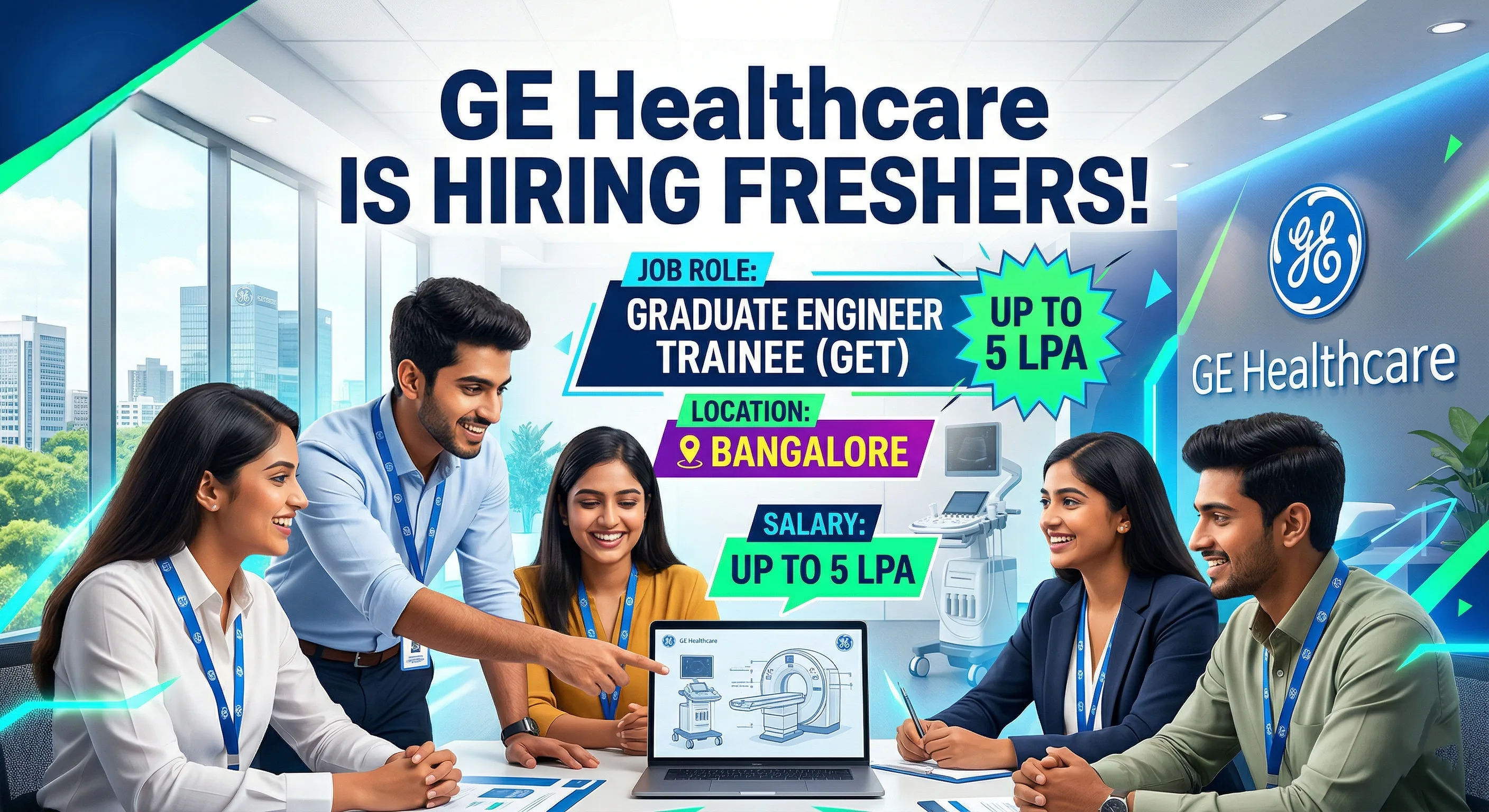
If you are a fresher from Electrical, EEE, ECE, Mechanical, or Mechatronics and you have been waiting for a role that gives both plant-floor exposure and real quality-engineering experience, this is one of the strongest openings right now. GE HealthCare is hiring freshers for Graduate Engineer Trainee in Bengaluru (Whitefield), and the role is drawing high attention because it combines manufacturing process ownership, validation activity, calibration discipline, and cross-functional problem solving in a global medical technology environment.
The listing in circulation shows a compensation range around 4 to 4.25 LPA. In practical fresher discussions, total value can be interpreted up to 5 LPA depending on internal salary structure, allowances, and policy terms. Treat 4-4.25 LPA as the concrete listed range and up to 5 LPA as a possible overall value ceiling, not a guaranteed fixed number for every candidate.
Most applicants fail not because they are ineligible, but because they do not decode the JD correctly. This post fixes that. You will get role highlights, practical eligibility checkpoints, line-by-line responsibility explanation, what interviewers are likely to check, how to prepare in a short window, and the direct apply link. If you want this opportunity to become a real interview call instead of just another application number, read this fully before applying.
Table of Contents
- GE HealthCare Graduate Engineer Trainee 2026: Job Highlights
- Role Snapshot and Why This Opportunity Matters
- Eligibility and Fit Checklist
- Primary Responsibilities (Decoded in Simple Language)
- Skills Interviewers Actually Look For
- Salary, Career Trajectory, and Long-Term Value
- About GE HealthCare and Work Culture
- How to Prepare in 10 Days
- Application Strategy That Improves Shortlist Chances
- Also Read
- FAQs
GE HealthCare Graduate Engineer Trainee 2026: Job Highlights
| Company Name | GE HealthCare |
| Role | Graduate Engineer Trainee (Manufacturing Process and Quality Engineer Trainee) |
| Experience Required | 0 years to 1 year relevant exposure |
| Location | Bengaluru (Whitefield / Hoodi) |
| Openings | 10 (as mentioned in listing snapshot) |
| Applicants | 100+ (as indicated in listing snapshot) |
| Listed CTC | 4 to 4.25 LPA |
| Salary Talk in Market | Overall value discussed up to 5 LPA depending on components |
| Education | B.E/B.Tech (Electrical and Electronics preferred; allied branches considered in listing) |
| Role Category | Production, Manufacturing and Engineering |
| Industry Type | Electronics Manufacturing / Medical Technology |
| Apply Link | Direct link available in this article |
Role Snapshot and Why This Opportunity Matters
This is not a desk-only fresher role where you just update trackers. The JD signals operational ownership at the manufacturing line level. You are expected to support power electronics and RF coil line activity, handle quality deviations, maintain calibration schedules, support validation documentation, and coordinate with supplier quality plus cross-functional teams. That means your learning is not theoretical. It is process-critical.
For freshers, this kind of role is valuable because it builds strong engineering habits early: evidence-based troubleshooting, documentation discipline, EHS awareness, and structured process improvement. GE HealthCare works in medical technology with strict standards, so this experience can strengthen your resume for future quality and operations roles.
Eligibility and Fit Checklist
Use this checklist before applying so your application is role-aligned:
- Qualification: B.E/B.Tech graduate, preferably in Electrical and Electronics. ECE, Mechanical, Mechatronics, and allied streams are also referenced in education mapping.
- Experience: Fresh graduates or candidates with up to one year relevant experience.
- Location readiness: Willingness to work from Bengaluru (Whitefield/Hoodi area).
- Process mindset: Interest in manufacturing process, quality control, and compliance tasks.
- Documentation ability: Comfort with preparing reports, maintaining revision history, and handling engineering communication.
- Team collaboration: Ability to work with production, quality, supplier teams, and engineering support functions.
Eligibility is only entry. Fit is what gets interviews. If your resume is pure software-focused with no reference to process, quality, lab, maintenance, manufacturing project, or instrumentation exposure, your profile may look misaligned. If you have even one relevant academic or internship project around electrical systems, diagnostics, validation, calibration, or production workflow, highlight it clearly.
Primary Responsibilities (Decoded in Simple Language)
The original JD lists many responsibilities. Here is what they mean in real working terms:
- Manage Power Electronics and RF Coil line: Support line stability, output flow, and day-to-day issue escalation.
- Resolve quality issues: Investigate defects and coordinate corrective action with relevant teams.
- Handle calibration discipline: Ensure schedule adherence and maintain calibration records.
- Support verification and validation: Assist with process/equipment checks and V&V documentation.
- Assist installation and maintenance: Support equipment readiness and follow-through activities.
- Manage non-conforming materials: Track rejection reports, segregation areas, and closure cycles.
- Coordinate with supplier quality: Follow up on rejected parts, rework, and closure timelines.
- Maintain work instructions and DHR: Keep revision-controlled documents current and traceable.
- Support engineering change communication: Ensure updates reach cross-functional teams clearly.
- Train production teams on process changes: Help improve adoption and consistency on the floor.
- Drive quality, cost, productivity improvements: Contribute practical ideas based on line realities.
- Support EHS and asset traceability: Follow safety practices and maintain inventory clarity.
- Contribute to Kaizen/Lean/Poka-Yoke: Participate in continuous improvement and mistake-proofing projects.
If you read this carefully, one thing becomes clear: this role rewards candidates who are methodical. You do not need ten certificates. You need engineering clarity, process awareness, and reliable execution habits.
Skills Interviewers Actually Look For
For this role, interviews are usually not only about theoretical branch questions. Recruiters and interviewers often check whether you can operate inside a quality-sensitive manufacturing environment. Focus on these areas:
- Manufacturing process basics: Understand flow, bottlenecks, defect points, and line discipline.
- Quality fundamentals: NCR/non-conformance, CAPA logic, root cause analysis, Pareto, 5 Why, and basic problem-solving tools.
- Calibration understanding: Why calibration matters, traceability concepts, and impact on final quality.
- Validation mindset: Difference between verification and validation, and why documentation evidence is essential.
- EHS awareness: Safety and compliance mindset in production settings.
- Lean/Kaizen orientation: Ability to identify small but practical improvement opportunities.
- Communication: Clear reporting, concise handover, and professional coordination across teams.
What a strong fresher answer sounds like
Avoid generic lines like "I am hardworking." Instead, explain one real project issue, what data you observed, what action you took, and what changed after that action. This immediately shows ownership and practical thinking.
Salary, Career Trajectory, and Long-Term Value
The listing figure around 4-4.25 LPA is already competitive for a fresher quality-process trainee role in a top brand environment. Why is the "up to 5 LPA" conversation happening? Usually because candidates evaluate total compensation potential, role value, and future increments rather than only one fixed CTC line item. Still, always trust final offer letter values over market speculation.
From a career perspective, this role can open multiple pathways in 12 to 24 months if performance is strong:
- Manufacturing Process Engineer
- Quality Engineer
- Supplier Quality Engineer
- Validation Engineer
- Production Engineering Support
- Operations Excellence / Lean Support roles
What gives this role long-term advantage is credibility. Experience in a process-controlled medical technology environment increases trust in your profile when you apply to other high-compliance industries later.
About GE HealthCare and Work Culture
GE HealthCare is a leading global medical technology and digital solutions company focused on improving outcomes where healthcare impact matters most. The company is known for combining engineering rigor with real-world clinical relevance, which means quality standards are not optional; they are part of daily work culture.
The employer messaging also emphasizes inclusion, diversity, and equal opportunity. It highlights values such as humility, trust, transparency, ownership, integrity, and collaboration. For freshers, this environment can be useful because structured cultures often offer clearer expectations, stronger mentorship behavior, and better habit formation early in career.
Another important note from the company communication is recruitment safety: GE HealthCare does not ask candidates for payments to process documents, interviews, or visas. Always avoid unofficial channels asking for money in exchange for job offers.
How to Prepare in 10 Days
If you want to improve interview conversion quickly, use this focused 10-day plan:
- Day 1: Decode the JD and map each responsibility to one project/lab example.
- Day 2: Revise manufacturing flow, quality checkpoints, and defect handling basics.
- Day 3: Study calibration and traceability concepts with practical examples.
- Day 4: Prepare verification vs validation explanation with one case.
- Day 5: Learn NCR/CAPA basics and practice a simple 5 Why root-cause flow.
- Day 6: Revise Lean, Kaizen, and Poka-Yoke with one realistic use case each.
- Day 7: Build concise interview answers: intro, strengths, and why this role.
- Day 8: Rewrite resume bullets to show measurable outcomes.
- Day 9: Do one mock interview and improve weak answers.
- Day 10: Final profile clean-up and apply with confidence.
Resume checklist before applying
- Mention branch and core subjects relevant to manufacturing and quality.
- Add one project where you solved a reliability, quality, or process issue.
- Include tools you actually used, not generic keyword stuffing.
- Show any lab, internship, or workshop exposure to calibration, instrumentation, or process checks.
- Keep the resume crisp, accurate, and evidence-driven.
Common mistakes that reduce shortlist chances
- Applying with generic IT/software-only resume for a manufacturing-quality role.
- Ignoring documentation and traceability experience in resume points.
- Not preparing examples for quality issue resolution.
- Treating Lean/Kaizen terms as buzzwords without practical understanding.
- Giving inflated salary expectations without role awareness.
Application Strategy That Improves Shortlist Chances
Because applications are already high, speed alone will not help. Apply quickly, but apply correctly. Use a role-focused resume headline, include project examples linked to process/quality ownership, and keep your communication professional and specific.
If you get a screening call, avoid generic answers. Explain in clear language where you solved a technical issue, how you documented it, and what changed after your action. That is exactly the behavior this role seeks.
Final Takeaway
GE HealthCare Graduate Engineer Trainee in Bangalore is a strong fresher opportunity for candidates who want real manufacturing-process and quality-engineering exposure in a globally respected environment. The role is practical, responsibility-heavy, and highly relevant for long-term engineering growth.
Prepare with clarity, not hype. If you can demonstrate fundamentals, structured problem solving, documentation discipline, and willingness to learn, your chances improve significantly. Align your profile to the JD and apply early.
Important: hiring links can close early based on volume. Also never pay anyone for job processing in the company name.
Also Read
- Reliance Retail Hiring Freshers for Engineer Intern in Chennai
- Tektronix Hiring Freshers for SDE Intern in Bengaluru (Hybrid)
- CloudSEK Hiring Freshers for SDE Intern Frontend in Bengaluru
- Razorthink Hiring Freshers for Trainee Software Engineers in Bangalore
- Deltek Hiring Freshers for Associate Software Engineer in Bangalore
- DigiDxDoc Hiring Freshers for Frontend Developer Intern (Paid + PPO)
- Black March Studios Hiring Freshers for Web Development Intern (WFH)
- CloudEagle.ai Hiring Freshers for Associate Java Developer (Intern-to-Hire)
- Codemonk Hiring Freshers for Software Engineering Intern in Bengaluru
- Atlas AI Hiring Freshers for AI/ML Intern 2026
- GE Appliances Hiring Freshers for Technology Intern 2026
- Microsoft Hiring Freshers for Research Sciences Intern 2026
FAQs
1. Is this GE HealthCare role open for 2026 passouts?
The role is fresher-focused and generally aligned to recent graduates, including current-year passouts matching the qualification criteria.
2. What is the actual CTC for this role?
The listing shows around 4 to 4.25 LPA. Depending on compensation structure and policy, candidates discuss total value up to 5 LPA.
3. Is Mechanical branch eligible?
Yes, the role listing maps to allied engineering streams including Mechanical and Mechatronics along with Electrical-focused branches.
4. Is this purely a quality role?
It is a mixed role involving manufacturing line support, quality issue resolution, calibration discipline, validation support, and continuous improvement initiatives.
5. Do I need prior full-time experience?
No. Fresh graduates and candidates up to one year relevant experience are suitable as per role direction.
6. Is knowledge of Lean and Kaizen mandatory?
Mandatory depth is not expected for freshers, but practical understanding of Lean, Kaizen, and Poka-Yoke can improve interview performance.
7. How should I prepare for interview questions?
Prepare branch fundamentals, one quality-problem story, one documentation example, and one process improvement example from your projects or labs.
8. Where can I apply directly?
You can use the direct apply link provided in this article.