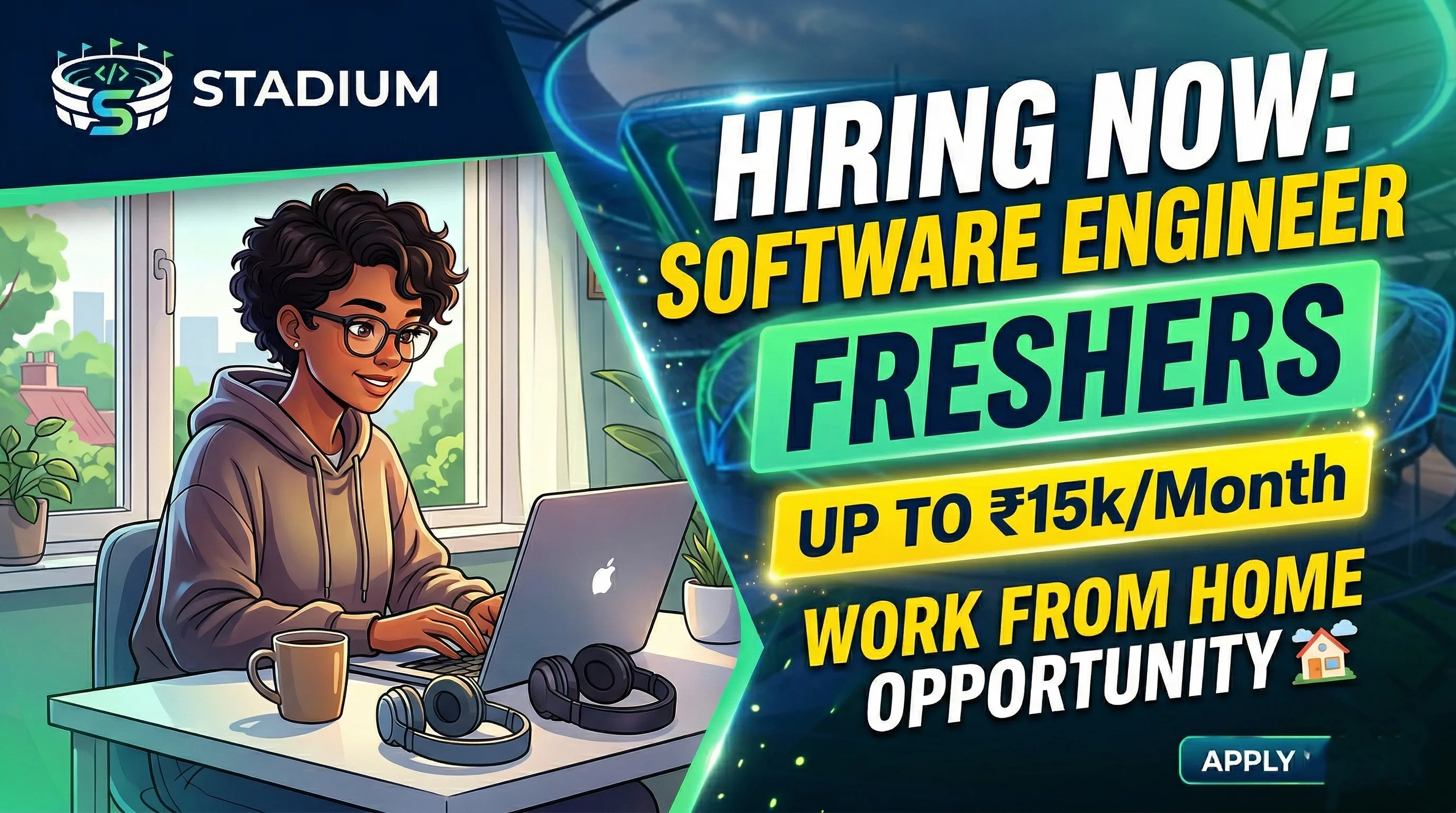
If you are a fresher from the 2026 or 2027 graduating batch and you want to start your career with a product-focused engineering team, this hiring update is worth your time. Stadium is hiring freshers for Software Engineer Intern work from home, and the role is getting strong traction because it combines real engineering exposure, mentored learning, and remote flexibility after training.
Many internship openings promise learning but end up with repetitive tasks. This one is different in positioning. The company is openly hiring for developers and QA engineers, which means you can grow into real product workflows instead of only watching from the side. You are expected to contribute, not just observe.
This article follows the same practical structure that worked well in our Reliance Retail intern guide and adds extra depth so you can prepare with clarity. You will get role highlights, eligibility breakdown, responsibilities in simple language, skill roadmap, training expectations, benefits reality check, and direct apply strategy in one place.
Table of Contents
- Stadium Software Engineer Intern 2026: Job Highlights
- Role Snapshot and Why This Internship Matters
- Eligibility Criteria and Candidate Fit
- Responsibilities Explained in Practical Terms
- Technical Skills and Interview Expectations
- Training to Remote Transition: What It Means
- Benefits and Career Value
- About Stadium and Product Environment
- 14-Day Preparation Plan Before Applying
- Application Strategy That Gets Shortlisted
- Also Read
- FAQs
Stadium Software Engineer Intern 2026: Job Highlights
| Company Name | Stadium |
| Role | Software Engineer - Fresher (Developers and QA Engineers) |
| Eligible Batches | 2026 and 2027 |
| Work Mode | Remote (Post-training) |
| Training Location | Patel Nagar, New Delhi |
| Employment Type | Full-time |
| Posted | 3 weeks ago (as listed) |
| Application Volume | Over 100 applicants |
| Minimum Academic Requirement | 85% in 10th and 12th |
| Skills Mentioned | DSA basics, problem solving, JavaScript, NodeJS, Python, Go, Ruby on Rails, QA fundamentals |
| Benefits | Health insurance support, flexible hours, 5-day work week, retreats, meal vouchers, swag |
| Apply Mode | Direct LinkedIn Easy Apply |
Role Snapshot and Why This Internship Matters
This role matters because it gives freshers access to both learning and execution. You will be working with engineering teams that build products used globally. That phrase sounds common in job posts, but here it has practical implications: requirements come from real users, release cycles are real, code quality is important, and collaboration standards are non-negotiable.
The second reason this opening is important is flexibility with direction. Some candidates prefer the development track, while others are stronger in testing and quality engineering. The post is clearly open to both pathways. This helps freshers who are still discovering where their strengths fit best.
Eligibility Criteria and Candidate Fit
Before applying, verify these points honestly:
- Graduation window: You should belong to 2026 or 2027 graduating batch.
- Academic baseline: Minimum 85% marks in 10th and 12th is part of the listed requirement.
- Education stream: Any graduate or postgraduate is accepted according to the post.
- Training readiness: You must be willing to attend in-office training in New Delhi.
- Learning mindset: Curiosity and ability to ask clear questions are strongly valued.
Eligibility is one part; profile fit is another. If you have basic coding projects, clear communication, and willingness to learn quickly, your profile can be strong even without prior full-time experience. On the other hand, if your resume has many skill keywords but no real projects you can explain, your interview confidence may collapse quickly.
Responsibilities Explained in Practical Terms
The official description uses standard company language. Here is what it means in day-to-day terms:
- Learn architecture and workflows: You will understand how the product is divided, where services live, and how code moves from development to release.
- Contribute to features: You may get frontend tasks, backend APIs, or QA automation tasks based on your track and team.
- Write maintainable code: Clean naming, small reusable functions, and testing discipline will matter.
- Work across teams: You will coordinate with product managers, designers, QA, and senior engineers.
- Join sprint rituals: Stand-ups, planning, and review meetings become part of your regular routine.
- Improve fundamentals: Teams still expect strong basics in data structures and logical reasoning.
- Use tools professionally: Git, code reviews, JIRA updates, and Agile process hygiene are expected.
- QA track specifics: Manual testing, test case thinking, bug reporting clarity, and automation exposure are prioritized.
A useful insight for freshers: communication quality is part of engineering quality. Many interns can code, but fewer can explain what they built, what broke, and how they fixed it. Those who can do both usually move faster.
Technical Skills and Interview Expectations
The role mentions multiple tech stacks such as Ruby on Rails, Python, Go, JavaScript, and NodeJS. This does not mean you must master all of them. It means the team is stack-diverse and values strong fundamentals over one-language memorization.
What interviewers are likely to evaluate:
- Problem solving: Can you break a problem into steps and justify your approach?
- Programming basics: Variables, data structures, loops, functions, objects, and error handling.
- DSA fundamentals: Arrays, strings, hash maps, recursion basics, and basic complexity awareness.
- Web basics: Request-response cycle, REST APIs, status codes, and JSON handling.
- Version control: Simple Git operations and understanding of pull request flow.
- Testing mindset: For QA-aligned candidates, writing test scenarios and edge-case thinking.
What a strong fresher answer looks like
Weak answer: "I know JavaScript and Node." Strong answer: "I built a task tracker with NodeJS and Express, created CRUD APIs, added JWT auth, and wrote basic validation middleware. I found a bug in duplicate task creation and fixed it using a unique index and error handling." The second answer sounds real and interview-ready because it includes decisions, not just keywords.
Training to Remote Transition: What It Means
One of the most attractive points in this role is the location model: New Delhi training first, remote work after training. Many candidates read this quickly and miss the practical meaning. Training phase is where the team evaluates your discipline, communication, and delivery quality. Remote phase gives autonomy, but only after trust is built.
To perform well in training:
- Show up prepared and on time.
- Take notes on architecture and internal terms.
- Ask concise questions after trying to solve first.
- Write progress updates clearly in Jira or team channels.
- Treat code reviews as learning, not criticism.
If you handle the training phase well, remote setup becomes a major career advantage. You get product-level work with location flexibility, which is increasingly important for work-life balance and long-term productivity.
Benefits and Career Value
The job post mentions multiple benefits: competitive salary aligned to skill level, mentoring by senior engineers, remote flexibility after training, flexible hours, five-day work week, retreats/offsites, meal vouchers, health insurance support, and company perks. For freshers, this is a healthy combination of financial and growth benefits.
But the biggest value is skill compounding. If you spend 8 to 12 months in a product team where you learn code quality, ownership, and shipping discipline, your next 3 to 5 years in tech can accelerate significantly. Internship outcomes are not only about immediate salary; they are about building proof of execution.
About Stadium and Product Environment
Stadium positions itself around building thoughtful products that create delight and connection for organizations globally. The core idea is combining creativity, data, and technology to make business interactions meaningful. In practical engineering terms, this usually means user-centric features, iterative releases, and cross-functional collaboration between design, product, and engineering.
14-Day Preparation Plan Before Applying
Use this focused plan if you want to apply with confidence:
- Day 1: Resume cleanup and role-specific headline update.
- Day 2: Revise arrays, strings, maps, and basic complexity.
- Day 3: Build a simple API using NodeJS or Python Flask/FastAPI.
- Day 4: Add input validation and clean error responses.
- Day 5: Build a small frontend page to consume your API.
- Day 6: Practice 5 debugging questions and explain fixes aloud.
- Day 7: Add one basic test file or QA test case sheet.
- Day 8: Push project to GitHub with clear README setup.
- Day 9: Learn pull request flow and branch naming basics.
- Day 10: Practice short self-introduction and project walkthrough.
- Day 11: Prepare answers for teamwork and feedback-based questions.
- Day 12: Mock interview with friend or self-recording.
- Day 13: Final role fit check: marks criteria, batch year, availability.
- Day 14: Apply with polished profile and tailored cover message.
Resume checklist for this role
- Add one project where you built something end-to-end.
- Mention quantified outcomes (for example, reduced API response time by X%).
- Keep skills truthful and interview-defensible.
- Show collaboration evidence: team project, code review, or testing ownership.
- Highlight quick learning examples from internships, hackathons, or college projects.
Common mistakes to avoid
- Applying without reading 85% academic requirement.
- Ignoring the training-in-office condition.
- Using generic resume objective copied from templates.
- Claiming too many technologies without project proof.
- Not preparing behavioral answers on ownership and feedback.
Application Strategy That Gets Shortlisted
This listing already has strong interest, so your strategy should be "fast + tailored" instead of only fast. Apply quickly, but update your resume summary and top project bullets to match this role before submission. If you can add a short, crisp cover note describing your relevant project and your readiness for New Delhi training, that can improve profile quality.
During screening, keep your answers practical. Tell them what you have built, what you learned from mistakes, and why this role fits your career direction. Interviewers remember candidates who are specific and clear.
Final Takeaway
Stadium hiring freshers for Software Engineer Intern work from home is a strong opportunity for 2026/2027 batch candidates who want real product exposure and a clear growth path. The training plus remote model is practical, the skill expectations are realistic for serious freshers, and the benefit stack is attractive.
Your biggest advantage will come from fundamentals and clarity, not from listing 20 technologies. Build one genuine project, explain your choices clearly, and show learning speed. That combination consistently performs better in fresher hiring rounds.
Important: hiring links can close early due to high applicant volume. Apply soon after verifying eligibility and polishing your profile.
Also Read
- Reliance Retail Hiring Freshers for Engineer Intern in Chennai
- GE HealthCare Is Hiring Freshers for Graduate Engineer Trainee in Bangalore
- Zensar Hiring Freshers for AI Engineer in GEN AI Projects
- CloudSEK Hiring Freshers for SDE Intern Frontend in Bengaluru
- CloudEagle.ai Hiring Freshers for Associate Java Developer (Intern-to-Hire)
- Codemonk Hiring Freshers for Software Engineering Intern in Bengaluru
- Black March Studios Hiring Freshers for Web Development Intern (WFH)
- DigiDxDoc Hiring Freshers for Frontend Developer Intern (Paid + PPO)
- Atlas AI Hiring Freshers for AI/ML Intern 2026
- Microsoft Hiring Freshers for Research Sciences Intern 2026
FAQs
1. Is Stadium fresher hiring open for both 2026 and 2027 batch?
Yes, the listing clearly targets graduates from 2026 and 2027 batch.
2. Is this role immediate work from home from day one?
No. Training is office-based in Patel Nagar, New Delhi. After training completion, the role moves to remote work mode.
3. Is 85% in 10th and 12th compulsory?
As per listed requirement, minimum 85% marks in both 10th and 12th are expected.
4. Which track can a fresher enter: developer or QA?
The hiring mentions both developer and QA engineer tracks. Final allocation can depend on team need and candidate evaluation.
5. Do I need to know all listed technologies like Rails, Python, Go, and Node?
No. You should have strong fundamentals and at least one practical stack with project proof. Curiosity to learn other technologies is important.
6. What kind of benefits are offered?
The post mentions competitive salary, health insurance support, flexible hours, five-day work week, mentoring, remote flexibility after training, retreats, and additional perks.
7. Where can I apply directly?
You can apply using the official LinkedIn job link included in this article.