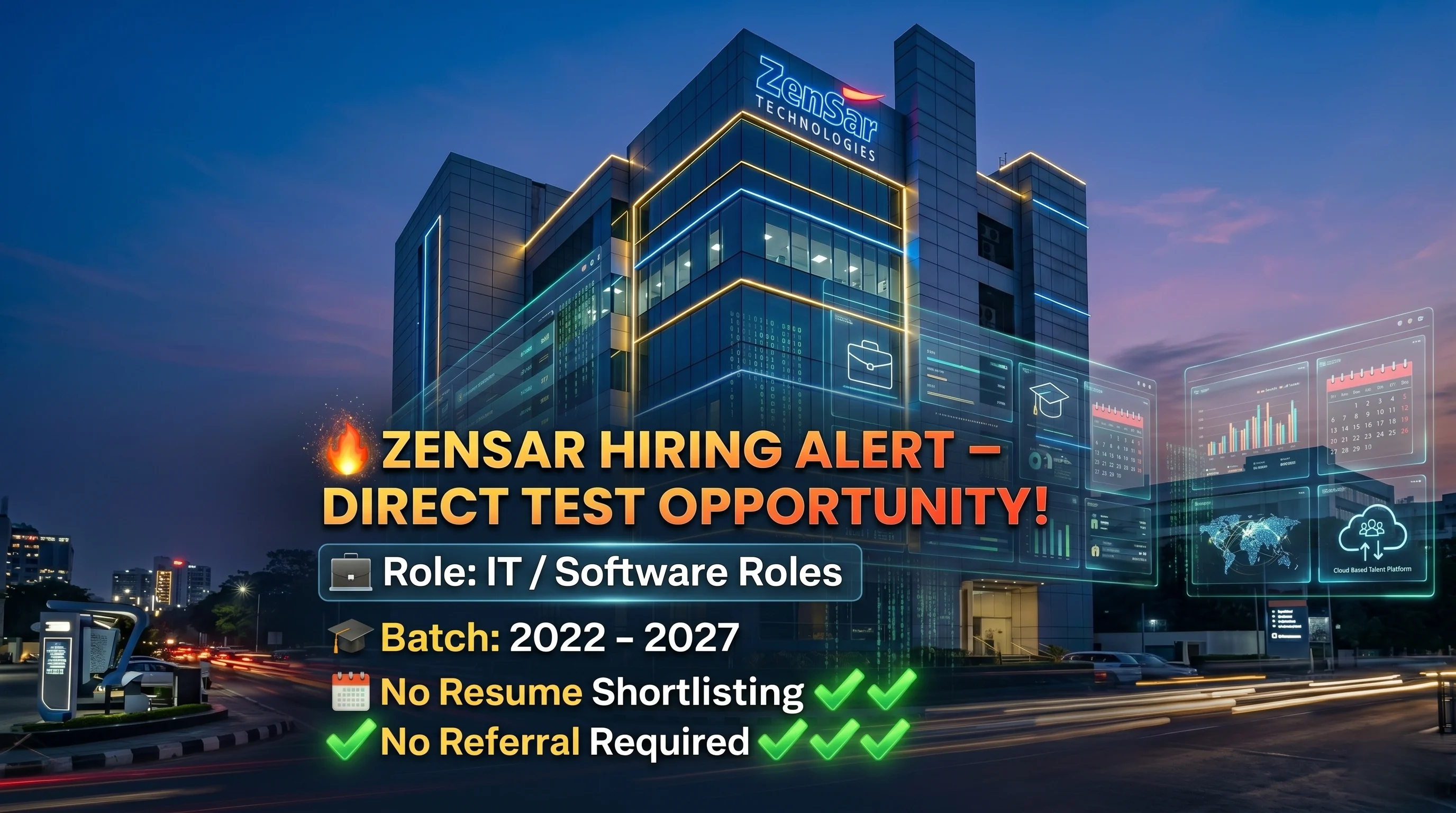
If you have been looking for terms like Zensar hiring 2026, Zensar test hiring, or Zensar AI jobs for freshers, this page is built exactly for that purpose. Instead of scattered job descriptions and unclear processes, this guide breaks down the entire Zensar direct test hiring 2026 in straightforward language that makes sense.
Most freshers miss opportunities like this because they do not understand what "AI annotation" or "prompt labeling" actually means. Many also do not realize that direct test hiring is often faster than traditional multi-round interview processes. If you are serious about landing a Zensar role with competitive salary and quick onboarding, this article walks you through every step.
This guide focuses on practical action. You will learn what Zensar is looking for, who can apply, how the test works, what salary you can expect, how long the entire process takes, and where to apply directly. Read this once, then use it as your application and preparation checklist.
Table of Contents
- Zensar Direct Test Hiring 2026: Quick Overview
- What Does Zensar Actually Do?
- AI Annotation, Labeling, and Prompt Engineering Explained
- Eligibility and Academic Requirements
- CTC and Compensation Details
- The Zensar Test: What to Expect
- Application Process Step by Step
- Preparation Tips for the Zensar Test
- Joining Timeline and Next Steps
- Application Form Fields and What to Know
- FAQs
Zensar Direct Test Hiring 2026: Quick Overview
| Company | Zensar |
| Hiring Type | Direct Test Hiring for Freshers |
| Roles Available | AI Annotation, Data Labeling, Prompt Engineering |
| Eligibility | Bachelor's or Master's degree in any relevant discipline |
| CTC Range | 3-6 LPA based on evaluation and project assignment |
| Selection Process | Direct test (no lengthy interview rounds initially) |
| Joining Time | 0-60 days after selection (flexible based on candidate availability) |
| Work Environment | Multiple AI projects, problem-solving focused team |
What Does Zensar Actually Do?
Zensar is not a startup trying things out. It is a subsidiary of RPG Group, one of India's largest conglomerates with a legacy spanning decades. The company specializes in digital solutions and technology services, which means they partner with global organizations across industries to help them achieve digital transformation. This is important for you to understand because it tells you something about work quality and project diversity.
With headquarters in India and offices across Mexico, South Africa, UK, and USA, Zensar operates at enterprise scale. When they hire freshers for AI roles like annotation and labeling, it is because these projects genuinely need this kind of work. You are not doing busy work. You are contributing to real AI training data pipelines that help larger systems learn and improve.
Why does this matter for you as a candidate? It means:
- Work Exposure: You will work on projects used by Fortune 500 companies. The standards are high, but so is the learning.
- Career Growth: Many freshers who start in annotation roles at Zensar transition to data engineering, QA roles, or even product teams within 1-2 years. Your growth potential is real.
- Global Presence: The company has global clients, which means exposure to international work standards and possibly future international project opportunities.
- Stability: RPG Group backing ensures the company is stable and not subject to startup-like volatility. Your job security is higher.
- Professional Environment: Unlike startups where roles blur, Zensar has clear structures, processes, and professional development paths.
That context changes how you should think about this opportunity. This is not just a job for salary. This is early exposure to how large organizations use AI, how data gets prepared for machine learning models, and how your work directly impacts product quality. Many candidates who realize this perspective perform better in interviews and test because they demonstrate genuine interest, not just desperation for a job.
AI Annotation, Labeling, and Prompt Engineering Explained
If you have never heard these terms before, do not worry. Let us break down each one so you understand what the role actually involves:
What is Data Annotation?
Data annotation means taking raw data (images, text, audio, video) and adding labels or descriptions to it in a structured way. For example, if you are working with images of traffic, you might label pedestrians, cars, traffic lights, and road signs, marking their exact location, size, and type. If it is text, you might identify named entities (person names, locations, organizations) or mark sentiment expressions. If it is audio, you might transcribe it or mark emotional indicators.
Why does this matter? AI models need millions of labeled examples to learn. Someone has to label those examples. That someone could be you, and Zensar is hiring for exactly that work. Your accuracy and consistency directly impact the quality of AI systems used globally.
Real Example: Autonomous vehicle AI needs to recognize pedestrians, cyclists, and obstacles. That means thousands of images of street scenes need careful annotation. Each mistake could have safety implications. The annotation work is critical and not trivial.
What is Data Labeling?
Labeling is similar to annotation but often more structured. You are assigning specific categories or tags to data based on clear rules. Think of it like filling out a structured form for each data item. You follow a guideline and mark whether something fits category A, B, C, or D. Consistency and accuracy matter intensely because the model depends on correct labeling.
Real Example: Customer feedback labeling: You read a customer review and mark it as "Product Quality Issue," "Delivery Delay," "Customer Service Problem," or "General Feedback." You follow priority rules so that ambiguous reviews are categorized consistently. 200+ reviews per day, high consistency required.
Why Precision Matters in Labeling: If 10% of your labels are wrong, the AI model learns incorrect patterns. That corrupts the entire training dataset. This is why Zensar is selective about who they hire and why accuracy is monitored closely after joining.
What is Prompt Engineering?
Prompt engineering is newer and increasingly important. It involves writing instructions or questions (prompts) that you feed to AI models to get useful outputs. If you are skilled at framing questions or instructions that get the AI to do what you want, that is prompt engineering. For instance, you might test different ways to ask ChatGPT something to get better responses, or you might create templates that guide AI to produce specific types of output.
Real Example: Instead of asking ChatGPT "Write about AI," you might ask: "Write a technical comparison between supervised learning and unsupervised learning, using 5 real-world examples, structured in 3 paragraphs, with a bullet-point summary." The difference in prompt quality dramatically changes output quality. Prompt engineers at Zensar test hundreds of variations to create optimized templates.
Why Prompt Engineering Skills are Valuable: As AI becomes more central to business, the ability to extract maximum value from AI models through smart prompting becomes a competitive advantage. Candidates skilled in prompt engineering often progress faster into higher-paying roles.
All three roles require strong problem-solving abilities and attention to detail. Zensar is looking for people who can think clearly, follow guidelines precisely, and adapt when something does not work as expected. The test measures these abilities, not specific domain knowledge.
Eligibility and Academic Requirements
Here is the good news: Zensar is flexible with academic qualifications for this hiring drive. Let us break down what they actually want:
- Degree Requirement: Bachelor's or Master's degree in any relevant discipline. Notice they say "any relevant discipline." This means engineering, science, commerce, even humanities backgrounds work. They are not being strict about major. If your degree is in psychology, sociology, languages, or even arts, you can still apply. Zensar values problem-solving ability over stream.
- Academic Performance: While minimum percentage is not explicitly stated in the form, they do ask for your 10th, 12th, graduation, and any postgraduate scores. This suggests they want to see consistent performance, not necessarily perfect scores, but also not concerning gaps. Someone with 55% in 10th, 60% in 12th, and 65% in graduation shows growth trajectory, which is often valued over flat excellence.
- Communication Skills: This is mandatory. Strong written and verbal communication in English is expected because the work involves understanding instructions clearly and documenting your observations accurately. If English is not your first language, focus on clarity over perfection. Write simple, clear sentences.
- Willingness to Learn: They explicitly mention this. You need to be open to learning new tools, processes, and technologies related to data annotation. This is AI space, things change fast, and they want people who adapt quickly without complaints.
What You Should Know About Eligibility:
- No minimum percentage cutoff is strictly mentioned, but consistent performance is preferred over dramatic swings.
- Professional experience is not required. Freshers are the target.
- No specific technical skills like coding are required (unless you apply for a specific role that requires it).
- Your field of study does not matter as much as your thinking ability.
- If you are still pursuing your degree and will graduate soon, you might still be eligible. Check with the form or reach out to Zensar's recruitment team.
The key takeaway: do not exclude yourself based on your academic stream or background. Apply if you have a relevant degree and you can communicate clearly. Zensar is more interested in your ability to think and learn than in a specific degree name.
CTC and Compensation Details
Let us talk money because that matters. The CTC range for Zensar direct test hiring is 3-6 LPA. That is a significant range, which tells you something important: your compensation depends on how well you perform in the test and which specific project you are assigned to.
Understanding the CTC Spectrum:
- 3-4 LPA Band: Typical for candidates with average test scores assigned to standard annotation projects. Includes salary, limited benefits, and sometimes performance bonuses.
- 4-5 LPA Band: For candidates with good test performance or specialized skill alignment (e.g., strong communication for prompt engineering roles).
- 5-6 LPA Band: For high performers, or candidates with relevant certifications or prior experience, or assignment to complex/specialized AI projects.
What CTC Includes:
- Base salary (typically 60-65% of total CTC)
- House Rent Allowance (HRA)
- Dearness Allowance (DA)
- Other Allowances
- Performance bonus (if applicable)
- Gratuity, PF, ESI contributions
Salary Growth Post-Joining: Many freshers who start at 3 LPA and perform well transition to higher-paying roles (QA, Data Engineering, Project Coordinator) within 12-18 months, often reaching 5-6+ LPA. The initial role is often a gateway to faster internal progression than traditional campus hiring.
For context, 3-6 LPA as a fresher is solid. It is above average for most entry-level tech roles in India, and it comes with the advantage of potentially learning enterprise-level AI practices from day one. Additionally, Zensar's stability means regular salary credits without delays, unlike some startups.
Negotiation: Is It Possible? Generally, Zensar offers are standardized based on test scores and project assignment. Individual negotiation at fresher level is limited but not impossible. If you have demonstrable skills or prior experience, you can politely request consideration, but do not overdo it. The company prefers meeting candidates with reasonable expectations.
The Zensar Test: What to Expect
This is what most people want to know. What is the actual test like? Here is what Zensar typically evaluates:
- Problem-Solving Ability: The test often includes logical reasoning and problem-solving questions. Nothing too complex, but they want to see how you approach a challenge you have not seen before. These might be puzzles, pattern recognition, or scenario-based questions where you need to find the most efficient solution.
- Attention to Detail: Since annotation and labeling depend on precision, expect questions or tasks that test whether you notice small differences or inconsistencies. You might be given two images and asked to spot 5 differences, or read through text to catch errors. One small mistake can compound in annotation work, so Zensar tests this rigorously.
- Understanding of Instructions: You might get a set of detailed instructions and have to apply them correctly to new scenarios. Can you read carefully, understand what is being asked, and execute accurately? That is what they test. This mirrors real annotation work where guidelines are strict and any deviation affects model quality.
- Data Classification Skills: You may be given sample data (images, text, audio descriptions) and asked to categorize them based on given criteria. This directly tests your readiness for labeling roles where accurate categorization is everything.
- Communication Assessment: Some candidates also go through a communication screening, especially if prompt engineering is involved. This might be a written assessment or a brief conversation to evaluate your English proficiency. They want to ensure you can document findings clearly and communicate edge cases to your team.
- Speed and Accuracy Balance: The test is usually time-bound. You need to complete it within the given timeframe without rushing or making careless mistakes. This tests your efficiency quotient, a critical metric in annotation work.
- Logical Reasoning with Domain Context: Some sections might present AI-related scenarios and ask how you would handle them. For example: "If you encounter conflicting annotation guidelines, what is your approach?" This tests your thinking when guidelines are ambiguous.
The good news is that this test is designed for freshers. They do not expect you to already know everything about AI. They are testing your fundamental aptitude and your ability to learn on the job. The entire test duration is typically 45-90 minutes, depending on the role and project complexity.
Test Pattern Breakdown:
- Logical Reasoning: 15-20 minutes (8-10 questions)
- Attention to Detail & Pattern Recognition: 15-20 minutes (10-12 tasks)
- Instruction Comprehension & Application: 15-20 minutes (5-8 scenarios)
- Communication & Writing: 10-15 minutes (3-5 short answers)
Application Process Step by Step
Zensar uses a structured application form. Here is what to expect and how to fill it correctly:
- Personal Information: Full name, email, mobile number, gender, and current location. Make sure these are accurate because this is how they contact you. Your email especially needs to be active and monitored daily, as test links are sent there.
- Educational Details: You will provide percentages for 10th, 12th, graduation, and any postgraduate degree. Be honest here. They cross-check with educational institutions. Even small discrepancies can lead to disqualification, so verify your scores before entering.
- Field of Study: Specify your degree stream or engineering specialization. If you studied something niche, you can explain it briefly. Zensar does not discriminate based on stream, so transparency helps.
- Current Employment Status: If you are working, name your organization. If not, write "NA" (not available). This helps Zensar understand your availability and context.
- Availability for Joining: Specify how many days you need before you can join (0-60 days range). Be realistic. If you say 10 days but need 30, it creates friction. Zensar wants people who can join reasonably soon, but they respect reasonable timelines.
- Source of Information: Tell them where you found this job posting (LinkedIn, Naukri, Monster, Social Media, Training Institute, College, Consultancy). This helps their recruiting team understand which channels work best.
After form submission, Zensar will review your profile and send you the test link if you match their initial criteria. The entire timeline from application to test is usually within a week. However, during busy hiring seasons, this could extend to 10-14 days.
Apply Here - Official Zensar Form
Preparation Tips for the Zensar Test
You have limited time to prepare, typically 3-7 days after getting the test link. Use it wisely with this structured preparation plan:
Week Before Test (If You Have Time)
- Practice Logical Reasoning: Solve 20-30 logic puzzles and pattern recognition problems. These are common in fresher-level tests. Use platforms like LeetCode, HackerEarth, or even puzzle apps. Focus on speed and accuracy equally.
- Detail-Focused Tasks: Do exercises where you spot differences, find inconsistencies in data, or match information. Websites like coglab or similar have free practice modules. Spend 30 minutes daily on these.
- Understand AI Basics: Spend an hour understanding what machine learning is, why training data matters, and how annotation feeds into ML models. This context helps you think better during the test. Watch YouTube videos on AI basics (3Blue1Brown has excellent content).
3 Days Before Test
- Read Instructions Carefully: Get used to reading lengthy instructions without skipping. In annotation and labeling, missing a small instruction detail can cost you entire accuracy sections. Take practice tests where you must follow complex guidelines exactly.
- Data Categorization Practice: If you have sample data or images, practice categorizing them quickly and accurately. This builds your mental model for how labeling works in real time.
- Polish Your Communication: If you are weak in English, practice writing short paragraphs and speaking clearly. Zensar will definitely assess this. Write 3-4 essays on tech topics and proofread them.
Day Before Test
- Light Review Only: Do not cram. Review one section of logical reasoning and one accuracy exercise. Your mind needs rest.
- Technical Preparation: Test your internet connection, browser, and system audio if any. Ensure your laptop has at least 50% battery or use a charger. Test all peripherals.
- Environment Setup: Clean your desk, eliminate distractions. Inform family members not to interrupt during the test window.
Test Day Strategy
- Do Not Overthink: The test is straightforward. Zensar is not trying to trick you. Read, understand, execute. Overthinking wastes valuable time.
- Time Allocation: If the test has sections with different difficulties, tackle easy ones first to build confidence. Then move to medium, then hard. This psychology helps maintain accuracy.
- Do Not Leave Questions Blank: If you are stuck on one question and time is running out, make an educated guess. Blank answers get zero marks, but guesses have a chance.
- Double-Check If Time Permits: In the last 5 minutes, quickly review your critical answers if time allows.
Free Resources for Preparation:
- LogiQuest (Free Logical Reasoning)
- HackerEarth Practice Problems
- YouTube - Abdul Bari (Algorithm Basics)
- Google Images - Find the Difference challenges
- Coursera - AI for Everyone (free audit mode)
Joining Timeline and Next Steps
After you pass the test, Zensar moves fast. Here is what typically happens:
Day 1-2 After Test Result: You will receive an email notification confirming your selection. The email will contain your tentative offer details, including role assignment, project code, and compensation band. Read this carefully. If you have any questions or clarifications needed, respond within 24 hours.
Day 3-5: Your formal offer letter will be sent. It will include your exact CTC, benefits, policies, joining date (based on your stated availability), and instructions for pre-joining documentation. At this point, you have the option to accept or decline. Most candidates accept within 24-48 hours of receiving this.
Your Stated Availability Window: If you said you can join in 30 days, Zensar schedules your joining within that window. Use this time to complete your notice period (if working), arrange accommodation (if required), and prepare mentally for the role.
Pre-Joining Documentation: You will need to submit documents like:
- Educational certificates (10th, 12th, graduation marksheets)
- Caste certificate (if applicable for reserved categories)
- PAN card and Aadhaar details
- Bank account information for salary
- Address proof
First Week - Orientation: Your first week is dedicated to orientation and onboarding. You will learn the specific annotation or labeling guidelines for your assigned project. You will also meet your team, understand the tooling setup, and get familiarized with the annotation platform or interface. Do not panic if this feels overwhelming. Everyone goes through it. Ask questions, take notes, and participate actively.
Week 2 Onward - Productive Work: By week two, you start handling real annotations or labels. Initially, your work will be reviewed by senior team members or QA experts to ensure you understand the guidelines correctly. After a week or two of close review, you transition to independent work. Your accuracy metric is tracked, and feedback is given regularly.
First Month Evaluation: Around day 30, there is usually an informal or formal check-in to see how you are progressing. Your accuracy scores, speed metrics, and learning curve are reviewed. This is also your chance to ask for clarifications or raise any concerns you have about the work or role.
The entire process from application to starting work usually takes 2-4 weeks if you are available to join quickly. If you have a notice period of 30 days, the entire cycle could be 4-6 weeks.
Application Form Fields and What to Know
The Zensar form has specific fields with validation rules. Here is what to watch for:
- Mobile numbers must be 10 digits (standard Indian format).
- Percentage scores must be between 35-100 for 10th, 40-100 for 12th and graduation.
- Joining availability is 0-60 days. Be honest here. Do not overcommit if you have other obligations.
- All fields with asterisks are mandatory. Do not skip any.
- Email should be a valid, active email (they will send test links here). Check spam folder after submitting.
- State and city fields are used for location preferences. If you prefer a specific location, mention it clearly in the optional notes if available.
Real-World Annotation Examples: What You Will Actually Do
To help you understand this better, here are real-world scenarios you might encounter in Zensar AI projects:
Example 1: Image Annotation for Object Detection
Imagine you are given 500 images of street scenes. Your task is to draw bounding boxes around all pedestrians and label them as "pedestrian_adult" or "pedestrian_child." You follow strict rules:
- Box must be tight around the person (no extra space)
- If partially visible, still include if more than 50% is visible
- Ambiguous cases are flagged and sent to senior annotators
Example 2: Text Sentiment Labeling
You receive customer reviews and must label them as Positive, Negative, or Neutral. A review like "The product arrived quickly, but it broke after two days" is tricky. It is both positive (quick delivery) and negative (quality issue). In such cases, you follow the priority guideline: prioritize the primary complaint. So this would be labeled Negative. You label 100-200 reviews per day, maintaining consistency.
Example 3: Audio Transcription with Annotation
You listen to a 30-second audio clip of a customer service call and transcribe it. Then you label emotional tone markers like "frustration," "confusion," or "satisfaction." You also note background noise or technical issues. This data trains AI to better understand customer sentiment from voice.
Common Mistakes Candidates Make (And How to Avoid Them)
- Misunderstanding the Application Form: Many candidates skip the optional fields or enter wrong information. Read every field twice. Zensar cross-checks everything.
- Not Preparing for the Right Skills: Students often prepare only for coding (LeetCode problems) when annotation is about precision and consistency, not speed. Focus on detail-oriented practice instead.
- Poor Time Management During Test: Spending 5 minutes on one hard question when you could skip and solve 4 easy ones. Learn to manage test time strategically.
- Overcommitting on Joining Date: Saying you can join in 5 days when you need 30. This shows poor planning and reduces reliability perception.
- Ignoring Communication Round: If there is a Versant or communication component, underestimating its importance. Many candidates clear the logic part but fail communication, which is critical for annotation work.
- Not Reading Instructions Carefully: In real annotation work and in the test, small instruction details matter. Missing one detail can invalidate an entire day's work.
- Panic During the Test: If you encounter a hard section, panic sets in and accuracy drops on easy sections. Stay calm. Move forward.
Also Read
- HCL Recruitment 2026 for Freshers: HCLTech Campus Hiring Complete Guide
- NITI Aayog Government Internship 2026: Full Eligibility, Duration, and Apply Guide
- UIDAI (Aadhaar) Is Hiring Freshers for Technology Intern 2026 in Bengaluru
- Astra Security Is Hiring Freshers for AI Engineer Intern (Hybrid Bengaluru)
- Esync Technologies Is Hiring Freshers for Software Engineer Intern (Work From Home)
- Infrrd Is Hiring Freshers for Software Development Engineer - Trainee in Bangalore
- Atlas AI Hiring Freshers for AI/ML Intern 2026
- RapidCue AI Hiring Freshers for AI Intern (Agentic AI)
- Predictive Data Sciences Hiring Freshers for Junior AI Builder
- CloudSEK Hiring Freshers for SDE Intern - Frontend in Bengaluru
Final Takeaway
Zensar direct test hiring 2026 is a genuine opportunity for freshers who want to enter the AI space quickly without prolonged interview cycles. The compensation is competitive, the work is meaningful, and the learning curve is steep in a good way. If you clear the test, you are in.
The winning strategy is simple: understand what Zensar is looking for, prepare your basics solid, fill the form accurately, and go into the test without anxiety. Do that, and you have a real shot.
Important: Always verify the current application link and process on Zensar's official careers page before applying, as recruitment details can change.
FAQs
1. Is Zensar direct test hiring really open for any graduate?
Yes, as long as you have a bachelor's or master's degree, any stream is acceptable. Zensar is more interested in your problem-solving ability and communication skills than your specific field of study.
2. How difficult is the Zensar test?
The test is designed for freshers, so it is not extremely difficult. It tests logical reasoning, attention to detail, and your ability to follow instructions. With some practice, most candidates can clear it.
3. What if I fail the Zensar test? Can I apply again?
Zensar usually allows reapplication after some time. Check their specific policy when you receive feedback on your test result.
4. Is work from home available in Zensar test hiring?
While not explicitly mentioned, data annotation and labeling can sometimes be done remotely. Ask about location and work arrangement specifics when you get the offer letter.
5. What is the difference between CTC 3 LPA and 6 LPA based on?
Your test performance, the specific project you are assigned to, and your background all factor into the final salary. High performers might start at higher LPA or get faster salary progression.
6. How long does it take from application to getting an offer?
Typically 1-2 weeks from application to test result, and 1-2 days from test result to offer. The entire process is quite fast compared to traditional hiring.